
PILPG Roundtable Blog
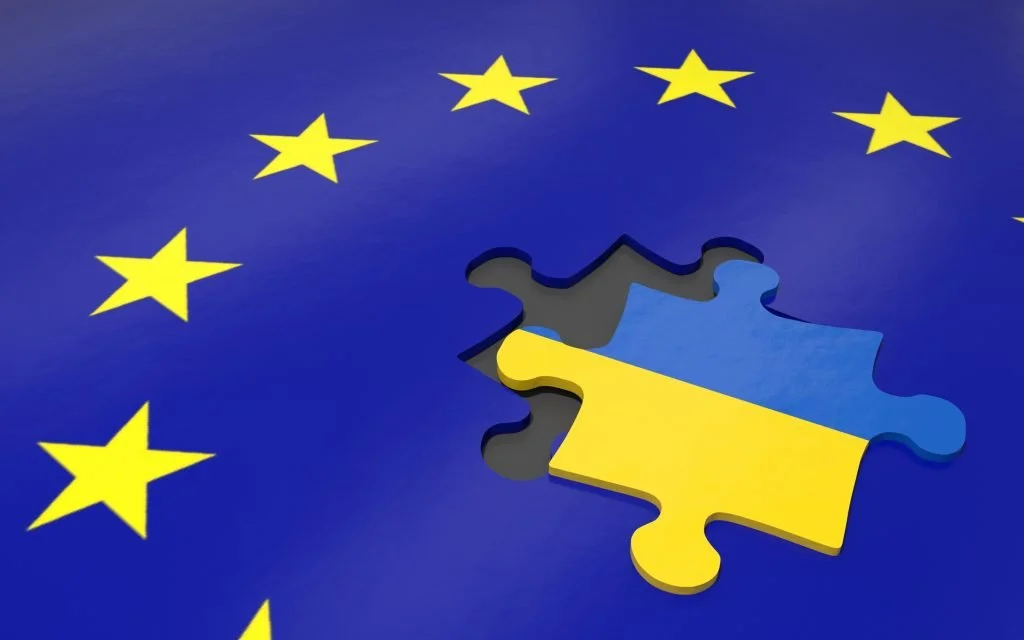
Part I: Ukraine’s EU Accession: Perspectives of Enlargement During the War
Editor’s Note
This roundtable explores one of the most consequential strategic questions facing Europe today: Ukraine’s accession to the European Union amid an ongoing war of aggression. Building on discussions within the Public International Law & Policy Group (PILPG) Ukraine Peace Negotiations Working Group, this piece brings together expert perspectives on how enlargement policy is being reshaped by geopolitics, security imperatives, and the pursuit of a just and durable peace.
Presented under the Lawyering Peace initiative, this roundtable situates EU accession not merely as a technical legal process, but as a defining test of Europe’s political will and strategic identity. As Ukraine continues to defend itself, its European trajectory has become inseparable from broader questions of deterrence, stability, and the future of the European project itself.
On 10 April 2026, members of PILPG’s Ukraine Peace Negotiations Working Group convened to assess the evolving trajectory of Ukraine’s EU accession process. More than a decade after the Maidan protests set Ukraine on its European path, accession now unfolds under radically different conditions: amid full-scale war, shifting transatlantic dynamics, and renewed debates about Europe’s strategic autonomy.
1. How should Ukraine’s EU accession be framed: as a technical enlargement process or as a strategic security imperative?
Dr. David Crane, Founding Chief Prosecutor of the UN Special Court for Sierra Leone and Founder of the Global Accountability Project
EU accession, in this context, stops being a checklist exercise and becomes something much sharper: a strategic decision about what Europe is prepared to stand for. One of the recurring themes in the discussion was that enlargement is among the few tools entirely in the EU’s hands. Using it decisively would send a message that is difficult to misinterpret, both to Moscow and to Europe’s own partners.
There is also a timing element. Moving forward now, rather than waiting for a more “convenient” moment, would signal that aggression does not freeze political integration. It also risks allowing Ukraine’s European trajectory to become implicitly negotiable in broader political or diplomatic processes, which is something that would fundamentally undermine its sovereignty. In that sense, the discussion also pointed toward the need for more flexible or even exceptional approaches to accession that reflect the realities of the current moment, rather than relying exclusively on peacetime models.
Chris Goebel, Senior Legal Advisor at PILPG
There was a clear sense that the EU is still speaking in two registers at once. On the one hand, Ukraine’s membership is framed politically as inevitable. On the other, the day-to-day discourse remains highly technical, concerning criteria, sequencing, absorption capacity.
The tension between those two narratives is becoming harder to sustain. Concerns about budgetary impact or institutional readiness are real, but they are being asked to carry too much weight. At some point, they need to be placed within a broader strategic frame, rather than quietly dictating the pace of the process.
Ambassador Joachim Rücker, former Special Representative of the UN Secretary-General and Head of the UN Mission in Kosovo
What has shifted, perhaps more than anything else, is the baseline. The question is no longer whether Ukraine belongs in the EU, but how quickly and through which mechanisms that can be realized. Recent discussions among foreign ministers suggest that this is now broadly understood across member states.
That does not mean there is agreement on method. But it does mean that enlargement in this case is no longer treated as routine. The legal framework has remained unchanged; the political context around it has not.
Ambassador Zorica Marić-Djordjević, former Head of the Permanent Mission of Montenegro to the World Trade Organization and Special Representative of Montenegro to the UN Human Rights Council
From a Western Balkans perspective, the risks of ambiguity are well known. When accession becomes slow, uncertain, or overly procedural, it stops stabilizing and starts producing frustration and drift.
In Ukraine’s case, that dynamic would be far more dangerous. Prolonged uncertainty along the EU’s eastern border is not a neutral outcome. It creates space for continued pressure, whether political, hybrid, or military. That is why enlargement here cannot be treated as business as usual, it has become part of Europe’s security policy in a very direct sense. As with earlier rounds of enlargement, integration serves to anchor stability over the long term and should not be allowed to become contingent on short-term political bargaining.
Any model of integration that introduces prolonged uncertainty or second-tier status would risk undermining that strategic function rather than reinforcing it.
Greta Ramelli, Legal Officer, Program Manager at the Public International Law & Policy Group
One constraint that keeps coming up, implicitly more than explicitly, is the domestic political one. Even where governments are aligned, public opinion is uneven. There is still a gap between elite consensus and what voters across the EU are prepared to support. Closing that gap will require a different kind of argument. Not just solidarity with Ukraine, but a clearer articulation of what accession delivers for the EU itself in different areas - economically, politically, and in terms of long-term independence.
Kateryna Kyrychenko, Head of Ukraine Legal Affairs and Program Management at the Public International Law and Policy Group
From the Ukrainian perspective, accession cannot be separated from the broader political and historical context of the war itself. Ukraine’s European course was not adopted opportunistically during the war, it became one of the central triggers of Russian aggression long before the full-scale invasion. The 2014 Revolution of Dignity and the Association Agreement process reflected a societal choice in favor of sovereignty, democracy, and integration with Europe. In that sense, Ukraine’s accession increasingly concerns more than technical compliance with accession criteria. It raises a broader question of whether the European Union views enlargement primarily as an administrative process or as a strategic instrument capable of responding to existential security challenges on the continent.
At the same time, prolonged uncertainty carries risks of its own. Leaving Ukraine in a prolonged geopolitical “grey zone” would not preserve stability, but instead sustain the very vulnerability and pressure that Russia has consistently sought to exploit.
2. What are the real political obstacles among member states to accelerating Ukraine’s accession and how can they be addressed?
Chris Goebel, Senior Legal Advisor at PILPG
The obstacles are not hidden, they are just often framed differently. “Absorption capacity,” budget concerns, and institutional balance, for example, are all real issues, but they also function as politically acceptable ways of expressing hesitation.
France was mentioned as a useful example: strongly supportive of Ukraine, but careful to anchor that support in a strictly merit-based process. That position is defensible, but it also slows things down in practice. The challenge is how to reconcile that caution with the strategic urgency that many of the same actors acknowledge.
Narratives within member states matter just as much as formal positions. Where enlargement is framed as a risk, it becomes politically costly; where it is framed as an opportunity, space opens up. Reframing Ukraine’s accession in terms of the areas it can contribute to (such as security, economic resilience, strengthening Europe’s global position) will be essential to shifting that balance.
Ambassador Joachim Rücker, former Special Representative of the UN Secretary-General and Head of the UN Mission in Kosovo
Legally, there is very little standing in the way. Article 49 remains the basis, and within it there is more flexibility than is sometimes admitted, for example with transitional phases, sequencing, differentiated timelines.
So the conversation ultimately returns to political will. If the decision is made to move faster, the legal tools are already there. If not, they will not move the process forward on their own.
Ambassador Zorica Marić-Djordjević, former Head of the Permanent Mission of Montenegro to the World Trade Organization and Special Representative of Montenegro to the UN Human Rights Council
Enlargement has never been purely technical, even if it is often presented that way. The Western Balkans experience shows how easily the process can become opaque and drawn out when political commitment weakens.
Ukraine’s case exposes that dynamic quite clearly. The framework allows for flexibility; the question is whether it will be used. Without that, references to criteria and procedures risk substituting for decision-making rather than guiding it.
Part of the response also lies on the Ukrainian side. Addressing known pressure points such as minority rights, rule of law, and institutional reform early and visibly can help neutralize resistance that tends to emerge in later stages. This is not simply about compliance, but about shaping the political environment in which decisions are made.
At the same time, however, the decisive factor at this stage lies with the European Union itself. Enlargement has always been driven as much by political determination as by technical readiness. A clear political decision to advance Ukraine’s accession would not bypass the criteria, but it would define the pace, sequencing, and credibility of the process. Without that signal, even substantial reform progress risks being absorbed into procedural delay. With it, the accession framework can operate as intended as a structured pathway toward integration, rather than an open-ended process that risks creating a sense of permanent limbo and eroding both credibility and momentum.
Dr. David Crane, Founding Chief Prosecutor of the UN Special Court for Sierra Leone and Founder of the Global Accountability Project
A broader point concerned the shifting international environment. Europe can no longer assume that its security framework will look the same as it has over the past decades. That reality should inform how decisions like enlargement are approached.
Waiting for alignment elsewhere may no longer be a viable strategy. In that sense, Ukraine’s accession is as much about Europe defining its own direction as it is about Ukraine joining. This opens the door to genuinely unconventional approaches to enlargement. Treating Ukraine as an exceptional case, where political commitment precedes full technical completion, reflects a growing recognition that existing models may not fully capture the realities of accession during wartime.
Greta Ramelli, Legal Officer, Program Manager at the Public International Law & Policy Group
Ultimately, this comes back to communication. If citizens across the EU do not see how Ukraine’s accession aligns with the Union’s core promises (prosperity, stability, security) support will remain fragile, regardless of elite consensus.
3. What model of phased or partial integration is most viable for Ukraine and what are the risks
Ambassador Joachim Rücker, former Special Representative of the UN Secretary-General and Head of the UN Mission in Kosovo
Phased integration is often presented as the practical compromise, allowing progress without forcing an immediate all-or-nothing decision. There is logic to that, particularly given the scale of the challenge.
At the same time, not all precedents translate well. The Cyprus model is often cited, yet its applicability is limited. Extending it (i.e. by admitting more members with unresolved territorial issues) raises broader political questions, not only for Ukraine but for other unresolved territorial situations in Europe. This makes the issue less a legal problem and more a political one, with implications beyond a single case.
Ambassador Zorica Marić-Djordjević, former Head of the Permanent Mission of Montenegro to the World Trade Organization and Special Representative of Montenegro to the UN Human Rights Council
The risk with phased approaches is not the concept itself, but how it is implemented. If it becomes open-ended, or if full membership feels perpetually out of reach, it can erode both credibility and political momentum.
That is something the Western Balkans know well. Any interim model for Ukraine would need to be clearly structured, time-bound, and visibly moving toward full integration, not replacing it.
Ukraine’s situation is fundamentally distinct. Any approach will need to reflect the reality of ongoing aggression while avoiding the creation of precedents that could complicate other regional dynamics.
Dr. David Crane, Founding Chief Prosecutor of the UN Special Court for Sierra Leone and Founder of the Global Accountability Project
There was also openness to more unconventional approaches. The idea of treating Ukraine’s accession as an exceptional case that includes moving politically first and resolving technical questions in parallel, would reflect the sense that existing models may not fully capture the current moment.
Whether such an approach is politically feasible is another question, but it illustrates how far the discussion has moved beyond standard enlargement thinking.
Concluding Observations
What emerges from the discussion is not a single answer, but a clear shift in perspective. Ukraine’s accession is no longer a conventional enlargement question. It sits at the intersection of security, political will, and the future shape of the European project.
Across the contributions, one point stands out: the legal framework is not the constraint. The flexibility exists. The real variable is whether member states are prepared to act on the strategic logic they already acknowledge. The risks of delay are not neutral. Prolonged ambiguity weakens credibility, invites instability, and allows external actors to shape the terms of Ukraine’s future. By contrast, a clear and politically anchored accession trajectory would reinforce Europe’s capacity to act decisively in a contested geopolitical environment.
Ultimately, Ukraine’s accession has become a test case. Not only for enlargement policy, but for whether the European Union can adapt its instruments to the realities of war and strategic competition. The outcome will signal far beyond Ukraine itself.