
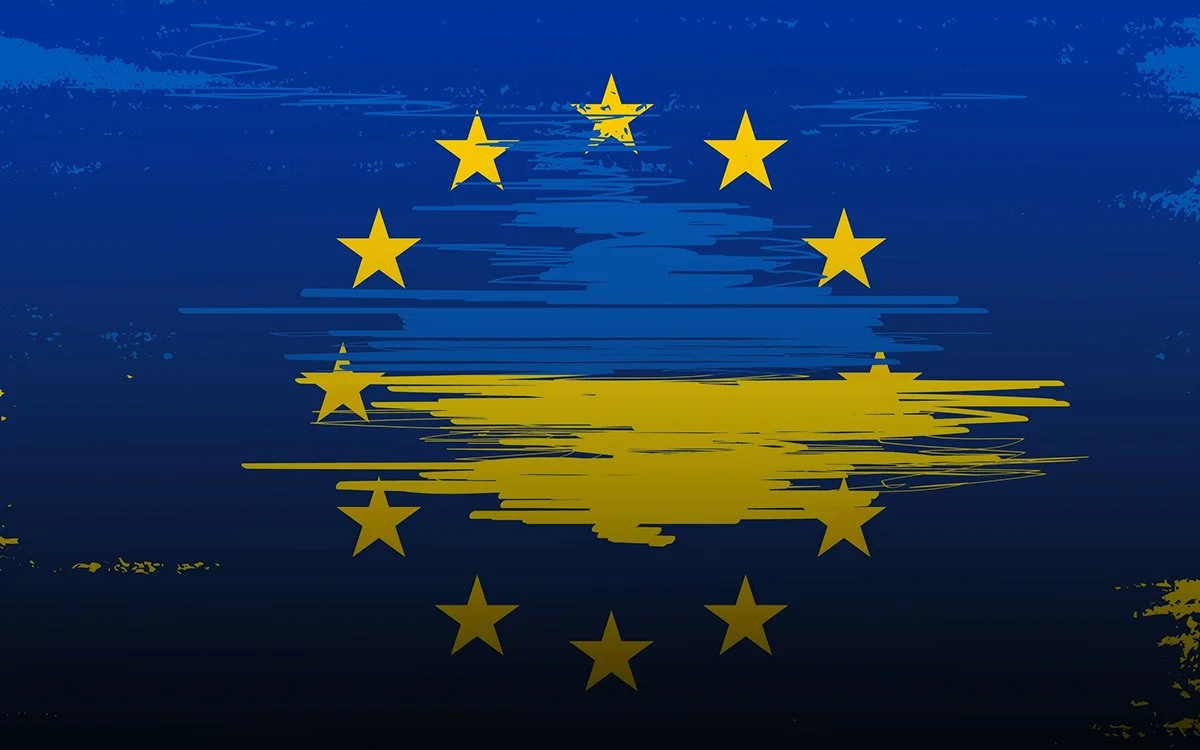
Extraordinary Accession: Why Europe Must Bring Ukraine
into the European Union Now
by David M. Crane*
Executive Summary
Europe stands at a geopolitical crossroads. Russia’s full-scale aggression against Ukraine has shattered the illusion that the post-Cold War order could be preserved through incrementalism, dialogue, or strategic ambiguity. Moscow is betting quite openly that Europe will hesitate, delay, and ultimately retreat from the historic question of Ukraine’s membership in the European Union. The Kremlin’s strategic calculation is simple: Europe will not bring Ukraine into the EU in the short or medium term, regardless of political declarations or symbolic gestures such as the Foreign Ministers’ meeting in Kyiv in March 2026.
This policy paper argues the opposite. Europe must bring Ukraine into the European Union now - not as a conventional accession, not as a “fast track,” but as an extraordinary accession that recognizes the singular nature of Ukraine’s struggle and the existential stakes for Europe itself. Political membership should be granted immediately, with the technical and treaty-based obligations phased in over time. This is not only feasible; it is strategically necessary.
Ukraine’s accession would send an unmistakable signal to Russia and the international community: Ukraine is Europe - permanently, irreversibly, and without qualification.
The Strategic Context: Russia’s Bet on European Hesitation
Russia’s war is not only a military campaign; it is a long-term strategy aimed at fracturing European unity and undermining the credibility of Western institutions. Central to this strategy is the belief that:
Europe will not take bold political steps that carry risk;
The EU will cling to procedural orthodoxy rather than geopolitical necessity;
Ukraine will remain in a gray zone - supported, admired, but not integrated.
This belief is reinforced by decades of European caution, slow enlargement processes, and internal debates over institutional reform. Even the March 2026 Foreign Ministers’ meeting in Kyiv, historic in symbolism, has not convinced Moscow that Europe is prepared to act decisively.
Extraordinary accession is the only response that breaks this strategic calculus.
Why Ukraine’s Accession Is Not a “Fast Track”, It Is a Different Category Entirely
Traditional EU accession is designed for states transitioning peacefully toward European norms. Ukraine is not in that category. It is:
a state defending Europe’s security architecture on the battlefield;
a democracy proving its resilience under existential threat;
a society already aligned with European values through sacrifice, not just legislation.
Ukraine’s accession should therefore be understood as as encompassing any and all of the following:
1. A political act of continental self-defense: bringing Ukraine into the EU strengthens Europe’s collective security, deters further Russian aggression, and stabilizes the eastern frontier.
2. A moral recognition of Ukraine’s role in defending European values: no candidate state has ever demonstrated its commitment to democracy, rule of law, and human dignity more clearly or at greater cost.
3. A strategic investment in Europe’s long-term stability: a secure, integrated Ukraine anchors the Black Sea region, strengthens energy diversification, and expands Europe’s economic and demographic base.
4. A precedent for extraordinary circumstances, not a shortcut for ordinary candidates: this is not a dilution of standards; it is an acknowledgment that Ukraine’s situation is unique in modern European history.
A Two-Track Accession Model: Political Membership Now, Technical Integration Over Time
To reconcile urgency with institutional integrity, the EU could consider adopting a two-track accession model:
Track 1: Immediate Political Membership
Ukraine becomes a full political member of the European Union with the representation in the European Parliament, a seat on the European Council, participation in EU foreign policy and security decision-making and access to EU political institutions and voting rights (with transitional arrangements as needed).
This step sends the decisive geopolitical signal: Ukraine is in Europe, and Europe stands with Ukraine.
Track 2: Phased Implementation of Treaty Obligations
Over a defined period, negotiated jointly, Ukraine would progressively adopt:
The acquis communautaire;
Single market regulations;
Judicial and administrative reforms;
Economic convergence measures;
Environmental and agricultural standards;
Customs and border integration.
This phased approach mirrors the EU’s own history of differentiated integration and acknowledges the realities of wartime governance.
Why Extraordinary Accession Serves Europe’s Interests
There are at least 5 arguments here:
1. It restores credibility to the European project: for years, the EU has been criticized for strategic timidity. Extraordinary accession demonstrates that Europe can act with purpose when history demands it.
2. It strengthens deterrence: Russia’s aggression thrives on ambiguity. Ukraine’s accession eliminates the gray zone that Moscow exploits.
3. It stabilizes Europe’s eastern frontier: a politically integrated Ukraine becomes a pillar of European security, not a buffer state.
4. It accelerates reconstruction and economic integration: EU membership unlocks investment, reduces corruption incentives, and anchors reforms in a durable institutional framework.
5. It reinforces the global rule-of-law order: Ukraine’s accession signals that borders cannot be changed by force and that democracies under attack will not be abandoned.
Addressing the Concerns: Why Extraordinary Accession Is Manageable
Concern 1: Institutional capacity
The EU has repeatedly adapted to enlargement. Transitional voting arrangements, phased integration, and opt-ins/opt-outs are well-established tools.
Concern 2: Economic disparities
Phased implementation of the acquis and targeted reconstruction funds can manage convergence without destabilizing existing members.
Concern 3: Security risks
Ukraine’s battlefield experience and intelligence capabilities strengthen, not weaken, European security.
Concern 4: Precedent for other candidates
The EU can clearly articulate that extraordinary accession applies only to states defending Europe against existential aggression.
Conclusion: A Defining Choice for Europe
Europe has reached a moment where hesitation carries greater risk than action. Ukraine’s accession is not merely a bureaucratic process; it is a strategic imperative and a moral obligation. It is the clearest possible signal to Russia that the era of spheres of influence is over and that Ukraine’s European future is non-negotiable.
By granting Ukraine extraordinary political membership now, with technical obligations phased in over time, the European Union affirms its identity as a community of values, not just a market, and demonstrates that aggression will never dictate Europe’s future.
Ukraine is Europe. The time to formalize that reality is now.
* David M. Crane is a PILPG Peace Fellow and global leader in international criminal justice and the founding Chief Prosecutor of the UN Special Court for Sierra Leone. He has spent decades shaping accountability mechanisms around the world, including serving as a driving architect behind the Special Tribunal for the Crime of Aggression against Ukraine. Crane is a distinguished scholar of international law, a former senior U.S. national security official, and a leading voice on the rule of law, state responsibility, and the legal limits on the use of force.