
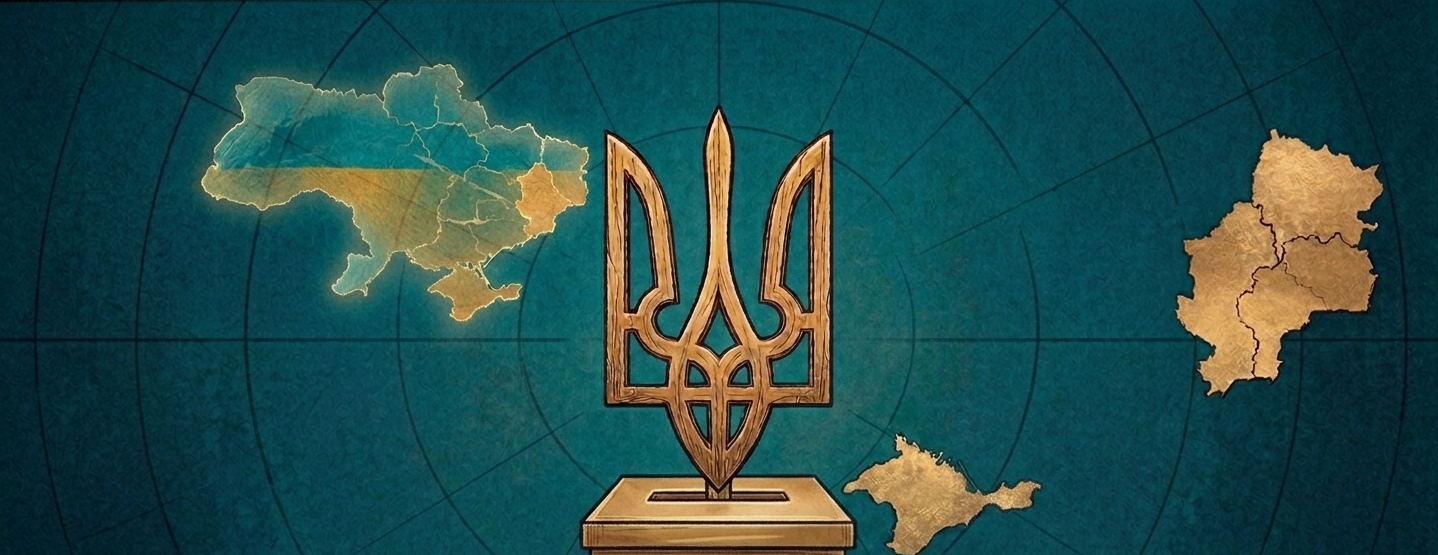
Why Russia’s Aggression Against Ukraine Cannot Be Cured by a Vote
A Legal and Historical Reality Check
By Greta Ramelli, Kateryna Kyrychenko, David Griffiths, Clyde Freeman, Anastasia Zaluckyj, Dmytro Panchenko and Rahul Ramesh
Introduction
A persistent assumption in some policy debates is that concessions of territories under Russia’s occupation will offer a pathway to ending Russia’s war against Ukraine. The Trump administration has repeatedly supported this thesis. While European officials have generally been more cautious, the possibility of territorial compromise has nevertheless entered public debate, including in Ukraine. Ukrainian officials have, however, distinguished between acknowledging the difficulty of restoring control by force in the near term and legally recognizing Russia’s claims over occupied territory.
Yet, this argument rests on a critical assumption that ceding territories would be sufficient to stop Russia’s aggression. This premise is far from settled. Analysts have repeatedly noted that Russia’s war aims extend well beyond Donbas, Crimea, or the mere acquisition of territory. The conduct of the war, characterized by war crimes and crimes against humanity, including systematic attacks on civilian infrastructure, forced deportations, and efforts to erase Ukrainian cultural identity, raises serious doubts about whether any concession, large or small, would meaningfully alter Russia’s strategic objectives. The trajectory of the war suggests the opposite: that Russia’s war is more than just an attempt to gain strategic territories and that ceding some territories is unlikely to bring peace.
Even if it is doubtful that territorial concessions would meaningfully alter the course of Russia’s campaign, it is still necessary to examine all potential scenarios that could influence how the war might eventually conclude. Considering these possibilities does not suggest that concessions are advisable or likely to succeed; it just reflects the need to understand the full range of legal, historical, and practical constraints that would shape any hypothetical settlement.
Assuming (purely for the sake of analysis) that territorial concessions could form part of a hypothetical negotiation, far more difficult questions immediately arise: how would such concessions be made? What legal mechanisms would be required? What constraints would international law impose? What limits does Ukrainian constitutional law create? And what can be learned from past conflicts in which referenda, territorial claims, or post‑conflict votes were used or proposed?
These questions are not abstract. They go to the heart of whether territorial concessions are legally possible and historically realistic, even before one considers whether they are politically desirable. This blog post therefore examines the legal architecture, domestic constitutional constraints, and historical precedents that shape what is and is not possible.
International Law Framework
The international legal order that emerged after 1945 is built on two core principles: the prohibition of the use of force and the prohibition of territorial acquisition through aggression. These rules are reinforced by the duty of non‑recognition, which obliges states not to accept territorial changes produced by unlawful force. This framework raises a foundational question: whether international law allows to legitimize a territorial change that originated in the use of force against a sovereign country and consequential occupation.
The historical development of modern international law strongly suggests that it does not. The modern international legal framework begins with the opposite presumption: under the United Nations system, territorial change achieved through force is presumptively unlawful. When the breach is sufficiently serious, other member states incur derivative obligations to not recognize the resulting situation as lawful and not to assist in maintaining it - principle of non recognition. That architecture exists for a reason. If an aggressor could seize territory first and then normalize the seizure through a vote conducted in the shadow of military coercion, the prohibition on acquisition by force would be emptied of its practical content.
For much of the eighteenth and nineteenth centuries, the law of nations did not truly prohibit conquest. On the contrary, conquest was widely treated as a recognized mode by which sovereignty over territory could pass from the defeated state to the victor, often formalized through peace settlement, acquiescence, or effective control.
WWI supplied the first decisive building blocks of that transformation. In the Pact of Paris of 1928, the major powers and many other states renounced war “as an instrument of national policy,” undermining the premise that war could remain an ordinary juridical mechanism for revising borders. The Stimson Doctrine, articulated after Japan’s actions in Manchuria, pushed the legal consequences of that shift further: the United States announced that it would not recognize territorial or treaty changes brought about by means contrary to the Pact of Paris. That move was noteworthy not merely as a diplomatic tool, but as a legal method. It translated the emerging anti-war norm into a rule of non-recognition, severing the traditional link between military success and legal title. In policy terms, the point was straightforward: if aggressors could keep the fruits of unlawful force, the nominal renunciation of war would be largely symbolic. Non-recognition was designed to prevent precisely that result.
The United Nations Charter turned the WWI shift into the foundational bedrock of the post-1945 legal order. Article 2(4) of the United Nations Charter prohibits any threat or use of force by one state against another that affects territorial integrity, political independence, or is otherwise inconsistent with the purposes of the UN. The International Court of Justice has explained that the two notions of threat or use of force stand together: if the contemplated use of force would be unlawful, the threat of using that force is also unlawful. International law and state practice overwhelmingly interpret “force” in Article 2(4) to mean armed force and subsequent international law instruments made increasingly clear that this prohibition was not simply about regulating hostilities but about denying legal rewards for coercive territorial revision.
The UN Security Council Resolution 242, adopted after the 1967 war, famously emphasized the “inadmissibility of the acquisition of territory by war.” The Friendly Relations Declaration of 1970 went further, stating that the territory of a state shall not be the object of acquisition resulting from the threat or use of force and that no territorial acquisition resulting from such force shall be recognized as legal. The 1974 Definition of Aggression gives concrete illustrations of the conduct at issue, identifying invasion, attack, military occupation, annexation by force, bombardment, blockades, and attacks on another state’s armed forces as exemplary cases. It further treats aggression as the most serious form of illegal force and provides that no territorial acquisition resulting from aggression shall be recognized as lawful. And the Helsinki Final Act of 1975 regionally consolidated the same principle by coupling territorial integrity and inviolability of frontiers with an express commitment that no occupation or acquisition produced by force would be recognized as legal. Together, these instruments reflect a legal system learning from earlier geopolitical catastrophes: peace and self-determination cannot survive if armed coercion remains a lawful pathway to sovereignty. Subsequent practice confirmed these principles (Jerusalem, Golan Heights, Namibia.)
Article 41 of the International Law Commission’s Articles on State Responsibility later codified the same point in general form: no state shall recognize as lawful a situation created by a serious breach, nor render aid or assistance in maintaining it. The subtending policy logic is again unmistakable. A prohibition on conquest would be too easily circumvented if third-party states remained free to normalize, finance, or otherwise stabilize the territorial outcome of unlawful force. Post-Cold War practice reinforced rather than weakened these principles. When Iraq attempted to annex Kuwait in 1990, the Security Council responded in no uncertain terms: annexation under any pretext had no legal validity and was null and void, and all states were called upon to not recognize it. The International Court of Justice’s (ICJ) 2004 Wall Advisory Opinion further linked the prohibition on territorial acquisition by force to the right of self-determination and to the obligations of third-party states. As summarized by the ICJ, the construction of the wall and its associated regime constituted de facto annexation, and all states were under an obligation not to recognize the illegal situation and to not render aid or assistance in maintaining it.
The international community’s response to Russia’s aggression against Ukraine is consistent with international law and state practice. In 2014, the UN General Assembly affirmed Ukraine’s sovereignty and territorial integrity, noted that the Crimea referendum had not been authorized by Ukraine, and stated that it could not form the basis for altering Crimea’s status; states were called upon not to recognize any status change based on that referendum. In the context of Russia’s full-scale aggression against Ukraine in 2022, Russia organized what the UN General Assembly called “illegal so-called referendums” in occupied parts of Donetsk, Luhansk, Kherson and Zaporizhzhia oblasts. The UN General Assembly held that those actions had no validity under international law and could not form the basis for altering the status of those regions, again calling on all states not to recognize any purported change.
In this sense, the problem is not only Ukraine’s sovereignty but the integrity of the global system itself. Any concession made while Russian forces occupy Ukrainian territory would therefore sit uneasily, if not incompatibly, with the core principles that underpin contemporary international law.
Domestic Law Framework
The second issue concerns Ukraine’s own domestic legal framework, which imposes independent and exceptionally stringent constraints on any attempt to alter the country’s territory. Ukrainian law contains a set of provisions that together form a territorial‑integrity safeguarding system. Ukraine’s Constitution defines the territory of Ukraine as indivisible and inviolable, assigns the protection of territorial integrity as a fundamental duty of the state, and requires that any change to Ukraine’s territory be approved by an all‑Ukrainian referendum.
These provisions are reinforced by two further constitutional limits that are decisive in the present context:
amendments to the Constitution may not be adopted during periods of martial law, and
no amendment may be oriented toward the violation of Ukraine’s territorial indivisibility.
Taken together, these rules mean that territorial concessions would in practice require a constitutional amendment, however the Constitution prohibits amendments during martial law. The first legal precondition for any territorial concession would therefore be the termination of martial law. Only once martial law is lifted could a constitutional amendment even be proposed, let alone submitted to the electorate under Article 73 of the Constitution. This structure raises a further question: even if martial law were lifted, could a referendum lawfully authorize the constitutional amendment needed to permit territorial concessions?
Holding A Referendum to Permit Territorial Concessions
The Constitution frames referenda as an instrument of popular sovereignty and one of the principal forms of direct democracy through which the people express their will. All citizens aged eighteen or older, except those deemed legally incompetent by a court, have the right to participate. The Constitution provides several pathways for triggering an all‑Ukrainian referendum. In the territorial context, Article 73 of the Constitution gives Ukrainian Parliament the authority to designate such a referendum. For amendments to Chapters I, III, and XIII of the Constitution, its Article 156 requires that the draft amendment be introduced by the President or by at least two‑thirds of the Parliament, adopted by a two‑thirds vote, and then approved by an all‑Ukrainian referendum designated by the President. A popular‑initiative referendum is also possible in principle, but under the 2021 Law of Ukraine “On all-Ukrainian referendum” it is limited to questions of nationwide significance and repeal of laws, and cannot be used for territorial‑change questions.
These mechanisms underscore that a referendum is not a free‑floating plebiscite. It is embedded in a constitutional sequence that presupposes the existence of a constitutionally permissible draft amendment. This is where Article 157 becomes central. Read together with the Constitution’s Article 2, which declares Ukraine’s territory indivisible and inviolable, and Article 9, which provides that treaties inconsistent with the Constitution may be concluded only after relevant constitutional amendments, Article 157 creates a substantial constitutional constraint on any theory that a referendum could be used to validate territorial concessions.
The referendum mechanism in Article 156 does not displace these limits; it operates only at the end of the amendment process and only if a draft amendment has already passed constitutional review. In practice, Article 157 creates both a substantive obstacle, as any amendment enabling territorial concessions may be deemed oriented toward violating Ukraine’s territorial indivisibility, as well as a temporal obstacle, because the amendment route is categorically closed while martial law remains in force. For present purposes, Article 157 is therefore not merely a background amendment rule. It is one of the central constitutional limits on using referendum‑based mechanisms to pursue a war‑ending territorial settlement.
The statutory framework reinforces these constitutional limits. The 2021 Law “On all‑Ukrainian referendum” defines the permissible subject matter of referenda and expressly prohibits questions that contradict the Constitution, violate sovereignty or territorial integrity, threaten national security, or contravene generally recognized principles of international law. For territorial‑change referenda, the Law adopts a treaty‑ratification model: a referendum does not ask voters whether territory should be ceded; it asks whether they approve a law ratifying an international treaty that changes Ukraine’s territory. The sequence is clear: a treaty is negotiated, the Parliament adopts a ratification law, and the referendum approves or rejects that ratification law. This design ties the referendum to the ordinary constitutional roles of the political branches and prevents the use of referenda as an alternative constitutional pathway.
The Role of the Constitutional Court of Ukraine
Throughout this process, the Constitutional Court of Ukraine acts as a mandatory constitutional gatekeeper through mandatory review in key stages of the process. It reviews the constitutionality of referendum questions and the acts calling a referendum, as well as the constitutionality of treaties altering Ukraine’s territory. It must also issue a preliminary opinion confirming that any draft constitutional amendment complies with Articles 157–158 of the Constitution before the Parliament may consider it. Opening constitutional proceedings automatically suspends the referendum process, and the Constitutional Court’s decisions are final and unappealable. This means that no referendum, no treaty, and no amendment can proceed if the Constitutional Court finds it unconstitutional, which acts as a critical safeguard in the context of territorial integrity.
Taken as a whole, Ukraine’s constitutional and statutory framework establishes a comprehensive legal architecture that leaves virtually little, if no room for territorial concessions. Because constitutional amendments are both substantively restricted and temporarily barred during martial law, no amendment enabling territorial change can even be initiated until martial law is lifted.
And even once that threshold is met, any proposed amendment would still have to survive the Constitution’s substantive limits on altering territorial indivisibility, pass through the heightened amendment procedure, and be submitted to a nationwide referendum. That referendum, in turn, cannot operate as a workaround: it comes only at the end of a constitutionally valid amendment process, and the 2021 Law of Ukraine “On all-Ukrainian referendum” prohibits questions that undermine sovereignty or territorial integrity.
Throughout this entire sequence, the Constitutional Court exercises mandatory and suspensive review, with the authority to halt or invalidate any step that conflicts with constitutional principles. In effect, Ukrainian domestic law does not merely make territorial concessions difficult. It constructs a layered system of constitutional and statutory safeguards that, under current conditions, renders such concessions legally unattainable under current constitutional conditions.
The Historical and Comparative Practice
The third issue concerns historical practice. Historical experience offers a clear answer to the question of whether territory seized through aggression can be legitimized through a referendum or similar process. Across a century of state practice, no credible precedent exists in which a territorial change produced by force was later validated through a vote conducted under occupation or coercive conditions. Instead, the record shows that legitimate referenda on territorial status have occurred only after the end of hostilities, the withdrawal of foreign forces, and the establishment of conditions that allow the population to express its will freely.
The Saarland
The Saarland plebiscite of 1935 illustrates this pattern. Although the region had been contested between France and Germany, the referendum took place only after fifteen years of League of Nations administration, the demilitarization of the territory, and the creation of a detailed legal and administrative framework overseen by international actors. Voter registration, dispute resolution, and security were all managed by neutral authorities, and both France and Germany formally pledged to abstain from pressure. The vote was accepted not because it ratified a territorial acquisition by force, but because it occurred in a demilitarized environment under international supervision. The Saarland example demonstrates that international administration and the absence of coercion are essential preconditions for a credible territorial referendum.
East Timor
East Timor’s 1999 independence referendum reinforces this lesson. After decades of violent Indonesian occupation, the United Nations organized and administered a vote on self‑determination. The referendum was held only after Indonesia agreed to allow it, and even then, the aftermath saw severe violence that required a multinational peacekeeping force and a UN transitional administration. The referendum’s legitimacy rested on the fact that it was not an attempt to validate Indonesia’s prior annexation, but rather a mechanism — facilitated by the UN — to end an unlawful occupation and restore self‑determination. East Timor shows that international involvement is indispensable when a population has been subjected to coercion or occupation, and that referenda cannot legitimize territorial changes produced by force.
Scotland and Catalonia
The experiences of Scotland and Catalonia highlight the centrality of constitutional legality. Scotland’s 2014 independence referendum proceeded only because the UK and Scottish governments negotiated a lawful pathway through a Section 30 Order. When Scotland later attempted to legislate a second referendum without Westminster’s consent, the UK Supreme Court held the measure unlawful. Catalonia’s 2017 referendum, conducted in defiance of the Spanish Constitution and in the face of active state opposition, was met with police intervention, judicial invalidation, and the suspension of Catalonia’s autonomy. These cases show that even peaceful, democratic referenda lack legal effect when conducted outside constitutional procedures, and that constitutional order is a prerequisite for any credible expression of self‑determination.
Kosovo
Kosovo represents an exceptional case shaped by mass atrocities, NATO intervention, UN administration, and the collapse of domestic governance structures. The International Court of Justice’s advisory opinion did not validate territorial acquisition by force; rather, it held that Kosovo’s declaration of independence did not violate international law because it did not purport to alter another state’s territory through aggression. Kosovo underscores that international law may accommodate alternative pathways only when ordinary constitutional processes are impossible due to severe human rights violations and the breakdown of state authority — conditions fundamentally different from attempts to legitimize territorial conquest.
Taken together, these precedents point to a consistent conclusion. Territory taken through aggression cannot be legitimized through a referendum or any other process conducted under coercion, occupation, or constitutional illegality. Legitimate territorial referenda require the withdrawal of occupying forces, the restoration of security, the reestablishment of constitutional order, and, in many cases, international supervision. Where these conditions are absent, the international community has uniformly rejected attempts to validate territorial change. Historical practice therefore reinforces what international law already makes clear: aggression cannot be cured by a vote.
Conclusion: Russia’s Unlawful Territorial Acquisition Cannot Be Cured
Under international law, Ukrainian domestic law and historical practice, the answer to whether aggression-based territorial change can be legitimized through a referendum is negative.
Under Ukraine’s constitutional framework, there is no lawful pathway to a referendum that could ratify a territorial concession. Any such treaty would immediately collide with the Constitution’s guarantees of territorial indivisibility, and Article 157 of Ukraine’s Constitution bars amendments that would undermine that principle while also prohibiting all constitutional amendments during martial law. Because the referendum mechanism operates only at the end of a valid amendment process, it cannot bypass these limits. As long as martial law remains in force, and as long as territorial integrity remains a constitutional constant, a nationwide vote cannot be used to legitimize the loss of Ukrainian territory.
International law reaches the same conclusion. Since 1945, the prohibition on aggression has been paired with the principles of territorial integrity, non‑recognition, and non‑assistance precisely to prevent an aggressor from converting military control into lawful title through later political formalities. The right of self‑determination does not authorize territorial transfers engineered under foreign occupation or coercion; it protects the free political will of a people, not outcomes produced in the shadow of force. Even if a referendum were somehow held after an unlawful seizure of territory, it would not retroactively validate the original breach or relieve other states of their obligation to withhold recognition from territorial changes procured by aggression.
Historical practice reinforces this legal structure. Credible referenda on territorial status have occurred only after the withdrawal of occupying forces, the restoration of security, and the creation of conditions that allow voters to participate freely. The Saarland, East Timor, and other internationally supervised processes demonstrate that legitimacy requires demilitarization, neutrality, and constitutional or treaty‑based authorization. Where these conditions were absent (as in Catalonia or in referenda conducted under occupation) the results were rejected. No historical precedent supports the idea that territory seized through aggression can later be legitimized by a vote.
Considered together, domestic constitutional constraints, international legal norms, and historical precedents all point in the same direction: legitimizing territorial concessions made under aggression lacks legal foundation and practical justification. And in any case, there remains scant evidence that such concessions would bring Russia’s campaign to an end.