
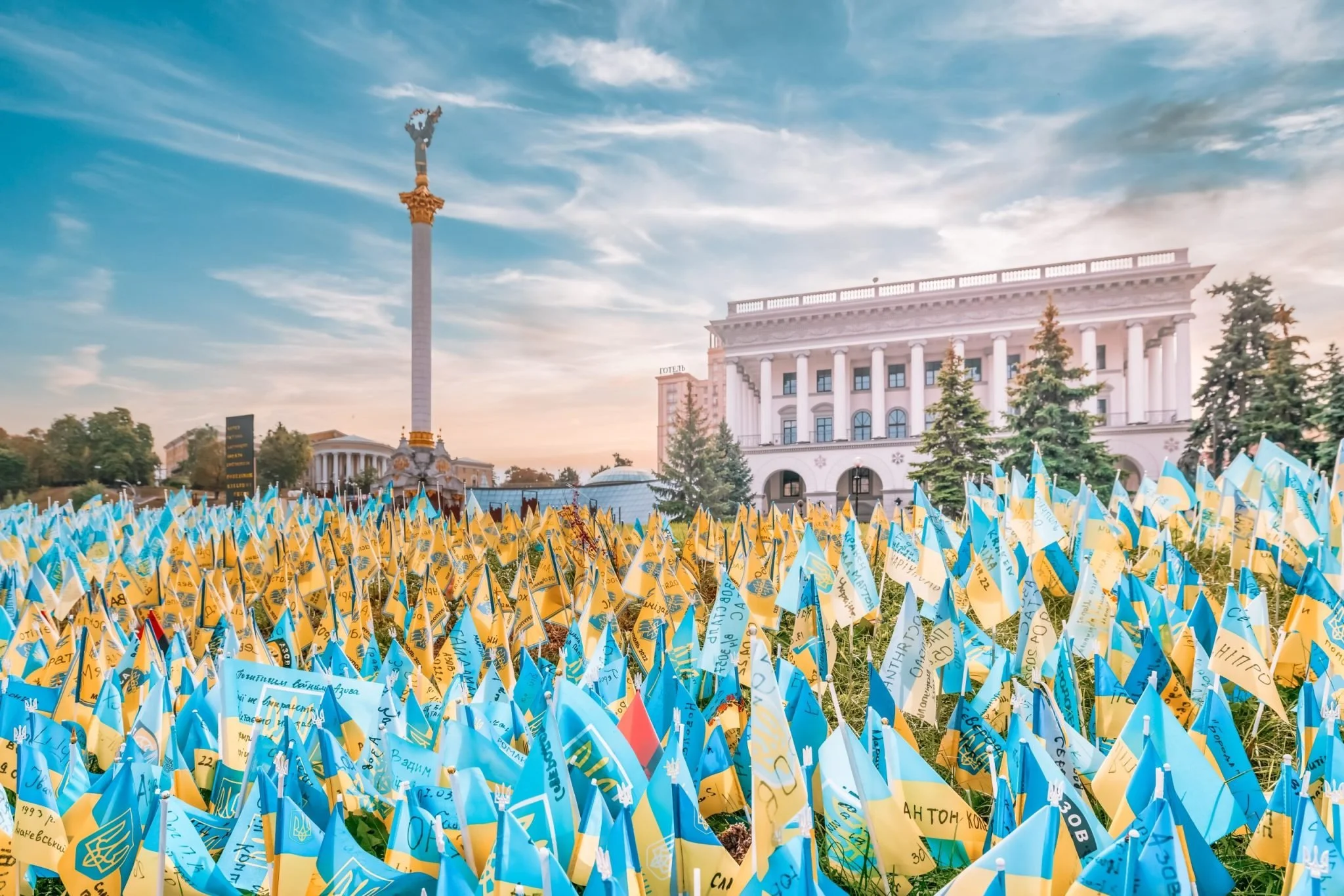
Roundtable Blog: Four Years Since Russia’s Full-Scale Invasion Into Ukraine: What Have We Learned?
Editor’s Note:
This blogpost is part of the PILPG Lawyering Peace roundtable series. Rather than a traditional co-authored article, it presents a curated set of expert reflections from members of PILPG’s Peace Fellows and Ambassador Circle networks. Marking four years since Russia launched its full-scale invasion of Ukraine on 24 February 2022, this roundtable examines how the war has reshaped international law, global security architecture, accountability mechanisms, and our understanding of modern aggression.
Anniversaries invite commemoration. This roundtable instead invites assessment. Four years on, the international community possesses insights that were unavailable in the early days of the invasion. The war has tested the resilience of collective defense systems, exposed the limitations and adaptability of international institutions, accelerated transformations in military technology and information warfare, and catalyzed new approaches to sanctions, energy security, and legal accountability. It has also revealed both the extraordinary durability of Ukrainian statehood and the profound human costs of prolonged high-intensity conflict.
This collection seeks to move beyond retrospective narrative toward forward-looking analysis. What assumptions proved mistaken? What institutional innovations have emerged? How has the legal framework governing aggression and atrocity crimes evolved under pressure? What lessons should policymakers internalize to deter future wars of aggression? By elevating diverse expert perspectives across disciplines, this roundtable aims to distill the most consequential lessons of the past four years — and to consider how they should inform the future of peacebuilding, deterrence, and the international legal order.
If February 2022 was a moment of shock, February 2026 is a moment of reckoning. What have these four years revealed about power, law, resilience, and the future of the international order?
Dr. Paul R. Williams, Rebecca Grazier Professor of Law and International Relations at American University
Four years into Russia’s full-scale invasion, the first and most striking transformation has been the acceleration of technological change in warfare. Artificial intelligence, autonomous systems, precision-guided drones, satellite-enabled targeting, and real-time data fusion have compressed decision cycles and expanded the battlefield into cyberspace and the electromagnetic spectrum. Ukraine has demonstrated how commercially available technology, agile software development, and decentralized innovation can offset traditional force disparities. The war has made clear that future conflicts will be shaped as much by code, algorithms, and adaptive manufacturing as by tanks and artillery.
Yet even as technology has evolved exponentially, the fundamental constraints of warfare remain stubbornly constant. Attrition still matters. Manpower, training, logistics, and industrial capacity continue to determine strategic endurance. Economic resilience based on energy security, defense production, fiscal sustainability has proven as decisive as battlefield ingenuity. The lesson of the past four years is therefore not that technology replaces fundamentals, but that it amplifies them. States that combine technological agility with demographic depth, industrial mobilization, and societal cohesion will shape the future of warfare; those that rely on innovation alone will discover that the enduring logic of war has not disappeared.
Second, the resilience and limits of the Euro-Atlantic alliance have come into sharper focus over the past four years. In February 2022, many assumed that the United States would continue to underwrite European security with little political friction. That assumption has eroded. Domestic pressures in Washington have sharpened scrutiny of asymmetric burden sharing, signaling that long-term U.S. support cannot be detached from questions of allied contribution and strategic reciprocity. The alliance has endured, but its internal equilibrium has shifted.
At the same time, the war exposed that Europe was militarily weaker and less prepared for high-intensity conflict than many believed. Stockpiles were thin, defense industrial capacity had atrophied, and rebuilding credible surge capacity is proving more difficult than many policymakers had assumed. Yet the war also catalyzed a remarkable strategic reawakening: increased defense spending, joint procurement initiatives, expanded production of ammunition and air defense systems, and a broader political acceptance that deterrence requires sustained investment. The lesson is not alliance fragility, but alliance recalibration — toward a more balanced distribution of risk, cost, and capability within the Euro-Atlantic community.
The next lesson learnt is that the economic sanctions policy as a tool to deter aggression remains strikingly anemic. Despite unprecedented coordination in response to Russia’s invasion, sanctions have struggled to produce rapid behavioral change or to meaningfully constrain a determined, resource-rich state. Financial restrictions, export controls, and asset freezes have imposed real costs, but they have not fundamentally altered strategic decision-making in Moscow. The limits are both institutional and structural. Institutionally, sanctions regimes are fragmented, unevenly enforced, and vulnerable to political fatigue. Structurally, decades of deep economic integration, particularly in energy, finance, and critical supply chains, created mutual dependencies that diluted deterrent credibility before the war and complicated escalation once it began. The lesson is sobering: sanctions can signal condemnation and incrementally degrade capacity, but absent broader strategic alignment and sustained enforcement, they remain an insufficient stand-alone mechanism for deterring wars of aggression.
Finally, over the past four years, it has become increasingly clear that this is not simply Russia’s war of aggression against Ukraine, but a broader war of aggression against Europe itself. The objectives extend beyond territorial control to reshaping the European security architecture, weakening transatlantic cohesion, and reasserting spheres of influence long thought obsolete. Energy coercion, cyber operations, election interference, disinformation campaigns, and calibrated military pressure along NATO’s eastern flank reveal a strategy aimed not only at Kyiv, but at the political and strategic unity of the continent.
Seen in this light, Ukraine has been the frontline, but not the sole target. The war has tested Europe’s energy resilience, industrial capacity, democratic institutions, and willingness to bear sustained economic and military costs. It has forced a reckoning with assumptions about post–Cold War stability and exposed how deeply European security remains intertwined with the outcome on Ukrainian territory. The central question is no longer whether Europe is supporting Ukraine, but whether Europe is defending its own security order through Ukraine.
Major General Darrell Guthrie, US Army (Ret.), PILPG Senior Peace Fellow
Four years into the war, Russia has failed to translate its initial ambitions into sustained strategic success. Since the early phases of the invasion and the subsequent Ukrainian counter-offensives, the Russian Army has been unable to generate a decisive offensive threat beyond the eastern oblasts it currently contests. At sea, the Russian Navy has largely withdrawn from active Black Sea operations, deterred by Ukraine’s innovative use of autonomous maritime systems. In response to battlefield constraints, Russian leadership has increasingly relied on ballistic missile and suicide drone attacks targeting civilian populations and critical energy infrastructure — a shift that reflects both strategic frustration and a continued willingness to weaponize terror.
At the same time, Ukraine’s military has demonstrated resilience, adaptability, and operational creativity. Ukrainian forces have integrated autonomous systems across the frontlines and conducted deep strikes against oil production and logistical facilities inside Russia. Despite earlier fears that fluctuations in U.S. support would create crippling ammunition shortages, coordinated domestic production and expanded European defense cooperation have significantly strengthened supply chains and replenished critical stockpiles over the past year.
Several lessons stand out. The Russian military remains anchored in a 20th-century attritional mindset, relying on mass and firepower rather than agility. In contrast, Ukraine’s experience underscores the importance of securing reliable supply chains, reducing operational restrictions on advanced weapons systems, and integrating autonomous capabilities at scale. The war has already reshaped how major powers assess force structure, industrial preparedness, and the role of unmanned systems in future conflicts. While the fighting continues, each failed Russian attempt to break Ukraine’s defensive lines or erode civilian resolve narrows Moscow’s strategic options and reinforces the long-term limits of coercive warfare.
Dr. David M. Crane, Founding Chief Prosecutor of the UN Special Court for Sierra Leone and Founder of the Global Accountability Project
Four years into Russia’s full-scale assault on Ukraine, the world has had time to absorb what this war has revealed — about Ukraine, about Russia, and about the international system that surrounds them. The war has not followed the script many expected in February 2022, and the lessons that have emerged are sobering.
First, Ukraine’s resilience has been extraordinary. What was supposed to be a quick decapitation strike instead became a national awakening. Ukrainians have shown that motivation, local knowledge, and a sense of existential purpose can outweigh assumptions about military size. Their ability to adapt — whether through drone innovation, rapid battlefield learning, or community-driven defense — has reshaped how modern resistance is understood.
Second, Russia’s strengths and weaknesses have both been laid bare. The early failures exposed deep problems in planning, logistics, and leadership. Yet Russia has also shown a capacity to absorb losses, reconstitute forces, and grind forward despite sanctions and diplomatic isolation. The war has demonstrated that an authoritarian state can sustain a long, costly conflict if it is willing to sacrifice its own people and economy to do so.
Third, civilians have paid the highest price. Millions have been displaced. Families have been separated. Children have grown up in basements, shelters, and foreign countries. Russia’s strikes on energy grids, apartment blocks, and public infrastructure have made civilian life unpredictable and dangerous. The humanitarian toll is not a side effect of the war — it is one of its defining features.
Fourth, the war has tested the cohesion of democratic alliances. Ukraine’s survival has depended on sustained Western support, and that support has not always been guaranteed. The war has revealed both the power of collective action and the fragility of political will. It has forced democracies to confront a basic question: how much does the international order matter when it is challenged by force?
Fifth, the nature of warfare is changing in real time. Drones, electronic warfare, satellite intelligence, and commercial technology have become central to the battlefield. The war has shown that large-scale land conflict in Europe is not a relic of the past, and that future wars will blend traditional combat with rapidly evolving digital tools.
Sixth, time itself has become a strategic weapon. Russia is betting that fatigue — political, economic, and emotional — will outlast Ukraine’s ability to fight and the West’s willingness to help. Ukraine, in turn, is betting that determination and international solidarity can outlast Russian coercion. The duration of the war has become part of the war. Time and distraction are Putin’s ultimate weapons.
Finally, the war in Ukraine has reshaped the landscape of international law. The invasion has revived global attention to the crime of aggression, a charge rarely pursued since Nuremberg. Ukraine’s partners have pushed for new accountability mechanisms, including a special tribunal focused specifically on Russia’s decision to wage an unlawful war. At the same time, the systematic targeting of civilians, forced deportations, and attacks on critical infrastructure have forced the international community to confront gaps in how atrocity crimes are investigated and prosecuted. The war has reminded the world that international law is only as strong as the political will behind it — and that accountability for aggression and mass harm cannot be an afterthought if the rules-based order is to survive. The bright red thread to atrocity accountability is political not legal.
In the end, the fourth anniversary offers no easy conclusions. What it does offer is clarity: deterrence cannot be assumed, borders are not self-enforcing, and the defense of a rules-based order requires more than statements of principle. Ukraine’s struggle is reshaping global security, and the lessons learned today will influence international politics for decades.
Ambassador Zorica Marić-Djordjević, former Head of the Permanent Mission of Montenegro to the World Trade Organization and Special Representative of Montenegro to the UN Human Rights Council
Four years on, any commemoration of Russia’s full-scale invasion must hold two realities together: the magnitude of devastation and the depth of Ukrainian resilience. The war has shattered cities, displaced millions, and reintroduced to Europe a form of industrial, attritional violence many believed had been confined to history. Yet it has also revealed a society capable of extraordinary mobilization, improvisation, and sacrifice, alongside an international coalition that, despite hesitation and internal divisions, has sustained Ukraine far longer than the aggressor and many observers initially expected.
Russia’s full-scale invasion of Ukraine has forced Europe to confront its own vulnerability, accelerating a shift from a market-driven union toward a more security-conscious, geopolitical actor. Power dynamics within the Union have subtly shifted: the Baltic and Nordic states, Poland, and Romania now carry greater influence on Russia policy; Germany has undergone a difficult strategic reorientation; and Finland and Sweden, long associated with neutrality, have joined NATO. As a result, the EU now speaks about its security, strength, and even its “destiny” in far starker terms than before 2022.
As the end of the war approaches, the prospect of some form of “emergency accession” or accelerated integration of Ukraine into the EU has shifted from a peripheral debate to a central test of European unity. A credible, fast tracked EU pathway would not merely reward Ukraine’s sacrifice but also function as a security instrument in its own right, anchoring Ukraine irreversibly within Europe’s political, legal, and economic space and raising the long term costs and complexity of any renewed Russian attempt to control Ukraine.
Ambassador Ylber Hysa, former diplomat of the Republic of Kosovo
In the years preceding the full-scale invasion of Ukraine by Russia in February 2022, intelligence warnings from the United States and the United Kingdom were met with skepticism across parts of Europe. This hesitation reflected the dominant post-Cold War paradigm: the assumption that large-scale interstate war in Europe had become structurally irrational. The skepticism felt reasonable, because leaders of Europe felt Russian invasion was not “rational”.
This paradigm rested on three core premises: economic interdependence reduces incentives for conflict; institutional frameworks provide mechanisms for dispute resolution; and state actors primarily calculate interests in material terms. Within such a framework, invasion appeared strategically self-defeating.
However, developments in 2021 indicated an alternative logic. Following the Geneva summit with the United States, Vladimir Putin increasingly articulated a historical narrative that challenged Ukrainian sovereignty. His interpretation of medieval statehood and shared origins suggested that identity and historical grievance, rather than economic calculation, were central to the Kremlin’s strategic worldview. The emphasis on historical continuity evokes comparisons within Russian discourse to transformative rulers such as Peter the Great or Joseph Stalin — figures associated with territorial expansion and centralized authority.
The invasion exposed miscalculations on multiple sides. European governments and Ukrainian leadership underestimated the likelihood of maximalist action. Russian planners appear to have underestimated Ukrainian resistance and Western cohesion. These reciprocal misjudgments highlight the limits of rationalist models when actors prioritize ideological or historical objectives.
The events of February 2022 may therefore represent the end of the post-Cold War security order in Europe. Rather than signaling the collapse of rationality per se, the war demonstrates the inadequacy of narrow materialist assumptions about rational behavior. States may act “rationally” according to internally defined ideological goals, even when such actions impose significant economic costs.
In this sense, the contemporary period could be conceptualized as a transition from liberal institutional optimism toward renewed geopolitical realism. Defense spending, alliance structures, and deterrence strategies have regained prominence.
At the same time, Ukraine’s resistance has challenged deterministic assessments of military capability. The conflict has also acquired normative dimensions, framed by many Western actors as a defense of sovereignty and liberal political order.
Whether this normative framing will shape the long-term structure of European security remains uncertain. What is clear, however, is that February 2022 marked a structural rupture in the assumptions that governed European politics for more than three decades.
Ambassador Joachim Rücker, former Special Representative of the UN Secretary-General and Head of the UN Mission in Kosovo
Four years into Russia’s full-scale invasion of Ukraine, the contrast with earlier responses to aggression within the United Nations system remains striking. Iraq’s 1990 invasion of Kuwait triggered swift and decisive action by the UN Security Council, culminating in the authorization of force and the rapid liberation of Kuwait. In the case of Ukraine, by contrast, the Security Council has been structurally paralyzed by the veto of a permanent member that is itself the aggressor. The comparison underscores both the promise and the vulnerability of the collective security framework established under the UN Charter.
Yet the story does not end with the Security Council deadlock. Faced with paralysis, the UN General Assembly has assumed a more visible and assertive role. Through emergency special sessions and repeated resolutions invoking the “Uniting for Peace” precedent, the General Assembly has articulated clear and sustained condemnation of Russia’s aggression and reaffirmed Ukraine’s territorial integrity. While its resolutions are not legally binding, they carry significant normative weight and demonstrate that multilateral legitimacy does not disappear when the Security Council fails to act.
This more assertive posture of the General Assembly is not accidental. It has emerged largely as a response to Russia’s war of aggression and the institutional vacuum created by Security Council inaction. The evolution of the Assembly’s role should not be overlooked amid competing global crises or diplomatic distractions. It reflects an effort by the broader membership of the United Nations to preserve the principles of the Charter when the primary enforcement organ is unable to fulfill its mandate.
Stephanie Gusching, Associate at White & Case, Secondee at the Public International Law and Policy Group
Four years after Russia's full-scale invasion of Ukraine, the war has exposed the structural weaknesses of the UN collective security apparatus. Under Articles 39-42 of the UN Charter, the Security Council (UNSC) is tasked with identifying threats to peace and authorizing collective, binding measures to combat them. However, Russia’s status as a permanent member of the UNSC has enabled it to veto draft resolutions condemning its actions and instituting remedial measures. This case illustrates a core weakness in the enforcement authority of a system dependent on the consent of the most powerful states: when a permanent member is itself the alleged aggressor, the system is functionally inoperative.
In response to UNSC paralysis, the UN General Assembly (UNGA) invoked the “Uniting for Peace” procedure to impose normative pressure on Russia. The UNGA adopted multiple resolutions with large majorities that condemned Russia’s invasion, affirmed Ukraine’s territorial integrity, and called for the withdrawal of Russian forces. However, the key weakness of UNGA resolutions is their non-binding nature. This demonstrates that while international law provides strong rules against aggression, it has comparatively weak mechanisms to enforce them.
By highlighting these weaknesses, Russia’s war in Ukraine has thus ignited discussion on reform within the UNSC. Proposals include voluntary veto restraint, mandatory abstention, and expansion of UNSC membership. However, the path to reform is laden with its own set of challenges, as amendments to the UN Charter require ratification by the permanent members whose very power would be curtailed.
Kateryna Kyrychenko, Head of Ukraine Legal Affairs and Program Management at the Public International Law and Policy Group
Four years into Russia’s full-scale invasion, one of the most visible changes has been the shift from discussing accountability to building it. In February 2022, many conversations about justice felt premature - almost theoretical - while the trajectory of the war remained deeply uncertain. Today, we are living with institutions that did not exist when the invasion began.
The foundations of the International Compensation Mechanism have been laid. The Register of Damage for Ukraine, the first chain of the Mechanism, is operational, creating a structured mechanism to document claims and prepare the groundwork for reparations. The Special Tribunal for the Crime of Aggression, established last year, marked a historic step in addressing leadership responsibility for the decision to wage an unlawful war. At the same time, international investigations have expanded across jurisdictions, and the International Criminal Court has issued six arrest warrants in the situation in Ukraine, which is a notably rapid pace by international criminal law standards. None of this eliminates the political challenges of enforcement. But it does show that international law is not static. Faced with gaps and paralysis, states and practitioners have demonstrated an ability to innovate — to create complementary mechanisms rather than accept impunity as inevitable.
Yet the legal architecture tells only part of the story. Civilian resilience has been the constant foundation beneath every institutional development. Local authorities continue governing despite repeated attacks. Civil society organizations document crimes while supporting displaced families. Energy workers restore power after each strike on infrastructure. Teachers, doctors, volunteers, and ordinary families have adapted to a reality of prolonged uncertainty without surrendering their sense of dignity or national identity.
For me, the lesson of these four years is that institutions and people sustain each other. Accountability mechanisms derive strength from a society that refuses to normalize aggression. And civilian endurance is reinforced by the knowledge that crimes are being recorded, named, and pursued. International law does not defend itself, it rather advances when communities insist that it must.