
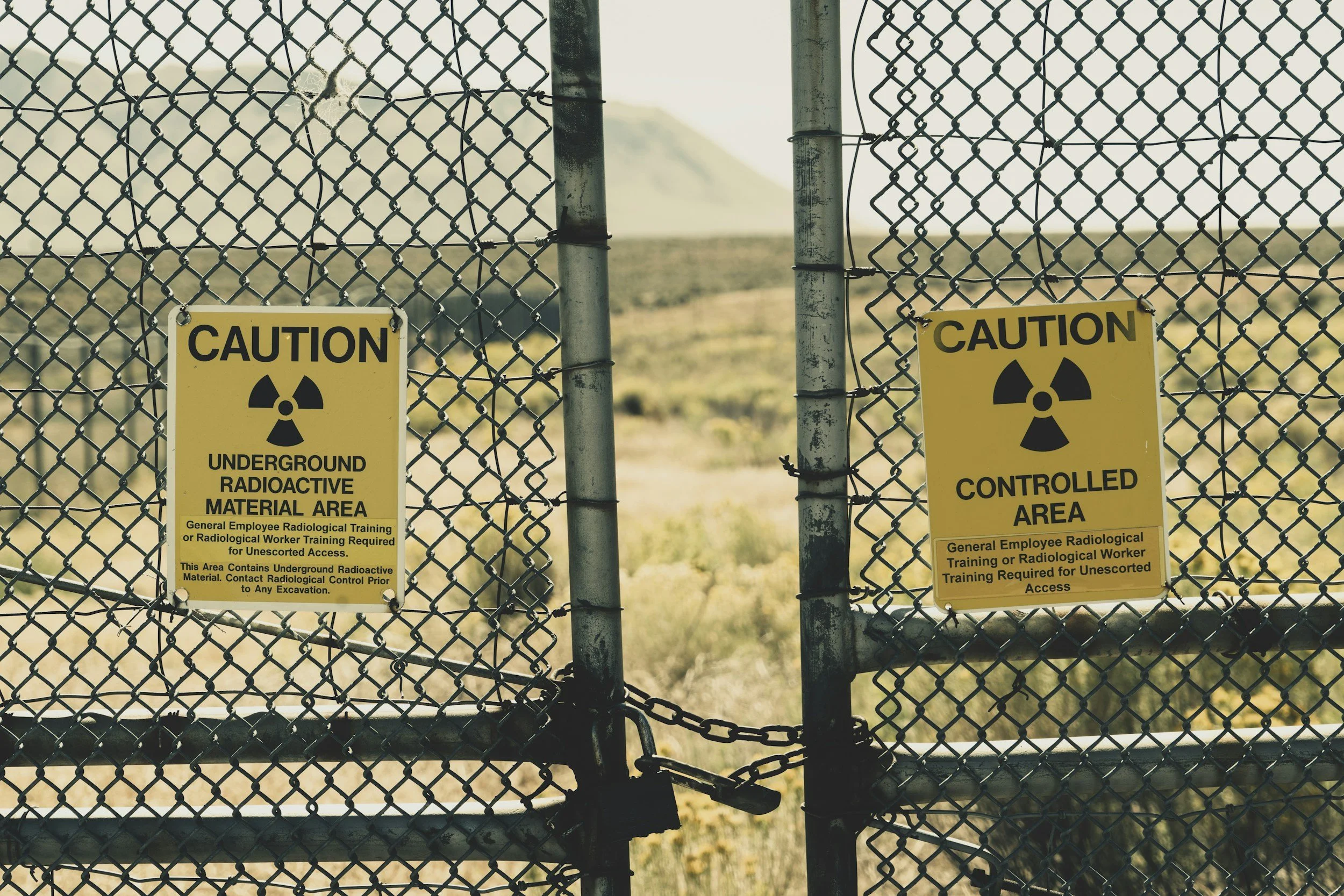
Nuclear Testing: An Inflection Point or Another Step Toward Confrontation?
By Ambassador (Ret.) Zorica Maric Djordjevic, Senior Peace Fellow, Public International Law & Policy Group (PILPG)
A New Round Begins in Moscow
By late October 2025, two troubling signals came from the world’s most powerful military nations — Russia and the United States.
The first move came from Moscow. President Vladimir Putin announced that Russia had completed tests of two nuclear-powered delivery systems. These were Burevestnik, a long-range cruise missile, and Poseidon, an underwater torpedo designed to devastate coastal regions with a radioactive surge. Both, reportedly, could evade existing missile defenses, creating a direct challenge to U.S. plans to build an expanded “Golden Dome.” Russian officials later clarified that both tests were non-nuclear, involving delivery systems rather than atomic warheads.
Within days, President Trump declared that the United States would keep pace with China and Russia and instructed the Department of War to resume nuclear-weapons testing. Officials later noted that such tests might involve system components rather than full detonations. Soon afterward, Washington unveiled its next-generation stealth nuclear cruise missile, the AGM-181 LRSO, signaling that the U.S. would match or outpace its rivals.
Putin responded by ordering the preparation of proposals for Russian nuclear testing should Washington proceed. “If the U.S. conducts such tests,” he said, “Russia must also take appropriate retaliatory steps.”
These exchanges rekindled the specter of superpower rivalry and signaled a return to competitive deterrence. For more than three decades, the Comprehensive Nuclear-Test-Ban Treaty (CTBT) has embodied a global consensus against nuclear explosions. Though the Treaty has not entered into force due to several key states not ratifying it (including the U.S., China, Iran, India, Pakistan, and North Korea), it has created a powerful informal norm. The global monitoring system of the Comprehensive Nuclear-Test-Ban Treaty Organization (CTBTO) ensures nearly certain detection.
Since 1996, only India, Pakistan, and North Korea have violated this norm, and each test was detected. Russia’s and Washington’s recent announced decisions risk unraveling this restraint:
Vertically, by legitimizing renewed testing and modernization among established nuclear powers.
Horizontally, by weakening the normative barrier that deters aspirants from pursuing nuclear weapons.
Arms control rests on predictability. The long-standing assumption that no major power would resume nuclear testing preserved a baseline of trust. Once that assumption erodes, the architecture weakens. A return to testing may not ignite an immediate arms race, but it increases uncertainty and shifts future negotiations toward escalation management rather than risk reduction.
A Global Ripple Effect
Moscow’s reaction following Putin’s initial comments remains mixed. While the Russian Ministry of Foreign Affairs sought clarity on whether Washington intended to conduct full explosive tests or limited system trials, Putin warned of reciprocal actions that could inject volatility into an already fragile arms-control architecture. Nuclear parity has long anchored Russia’s conception of sovereignty and great power status. Any U.S. move toward testing, even a symbolic one, is seen through this lens. Putin’s unveiling of new nuclear systems added a deliberate symmetry: technological display as diplomacy.
Moreover, the revival of nuclear testing reverberates far beyond the U.S.–Russia dyad. China, which has not conducted explosive tests in decades but continues to modernize its arsenal rapidly, may feel compelled to respond. Even a symbolic U.S. test could accelerate strategic competition among the three major powers and undermine the CTBT’s already fragile authority.
For smaller and non-nuclear states — from Eastern Europe and the Western Balkans to the South Caucasus — renewed great-power signaling produces deep unease. Their security rests on predictable conduct by major powers and the credibility of international law. When deterrence eclipses dialogue, these foundations weaken.
In contrast, large parts of the Global South, including Latin America, Africa, Southeast Asia, and the South Pacific, remain firmly committed to Nuclear-Weapon-Free Zones. Their stance underscores a widening divide between states anchored in legal restraint and those asserting power through capability.
The long-standing nuclear taboo, driven by political restraint rather than formal rules, is now less certain.
The Ukraine Factor: Negotiations Under Nuclear Shadows
The current nuclear signaling between Russia and the United States does not take place in isolation; the war in Ukraine directly shapes it. Nuclear security has become part of the negotiating environment itself, not a parallel or distant issue. As a result, any diplomatic endgame must now account for:
Why nuclear brinkmanship has intensified,
How it reshapes incentives and red lines of all parties, and
Why nuclear stability is becoming an important pillar of a future peace framework.
For Ukraine, the impact is double-edged. A more assertive U.S. posture offers reassurance, but it may also encourage Moscow to prolong the conflict in hopes of generating pressure on Washington. The risk is that negotiations devolve into a test of political endurance rather than a search for compromise — a dynamic in which deterrence logic overwhelms diplomacy.
Because recent Russian and U.S. announcements - from new Russian delivery systems to Washington’s intention to resume nuclear testing - demonstrate that strategic deterrence is once again contested, the new “28-point U.S. peace proposal” places renewed emphasis on credible Ukrainian security guarantees. These proposed “reliable guarantees” may fall short of full NATO membership and reportedly include meaningful restrictions on Ukraine, but they also reflect a core reality: when the nuclear threshold is publicly challenged, Ukraine’s vulnerability increases, and normative deterrence alone becomes insufficient. If deterrence is under strain at the nuclear level, it must be reinforced at the conventional and strategic levels for Ukraine. Without that reinforcement, any peace settlement risks becoming unstable – or even unworkable.
For Europe, caught between deterrence and diplomacy, the challenge is to keep communication channels open, especially for nuclear risk-reduction and humanitarian issues, even as the broader strategic environment hardens.
Ultimately, nuclear signaling does not close the door to negotiations, but changes their architecture. The task for Washington is to convert deterrence into diplomatic leverage, using strength not to foreclose talks, but to enable them. In the end, nuclear testing may strengthen military power, but it weakens trust, the essential currency of diplomacy. The world now stands between a harder peace or a more protracted war.
Between Deterrence and Diplomacy
If Washington and Moscow continue to define strength through demonstration rather than dialogue, the space for diplomacy — especially on Ukraine — will continue to contract. What emerges may not resemble the classical Cold War arms race, but something more unstable: a world where uncertainty itself becomes a strategic instrument.
Whether this moment becomes a turning point or merely another step toward confrontation depends on how the major powers act. Nuclear testing can stabilize deterrence or destabilize diplomacy. Managed wisely, it could remind all sides of the catastrophic costs of miscalculation and ground arms control. Mishandled, it risks opening a new cycle of escalation.