
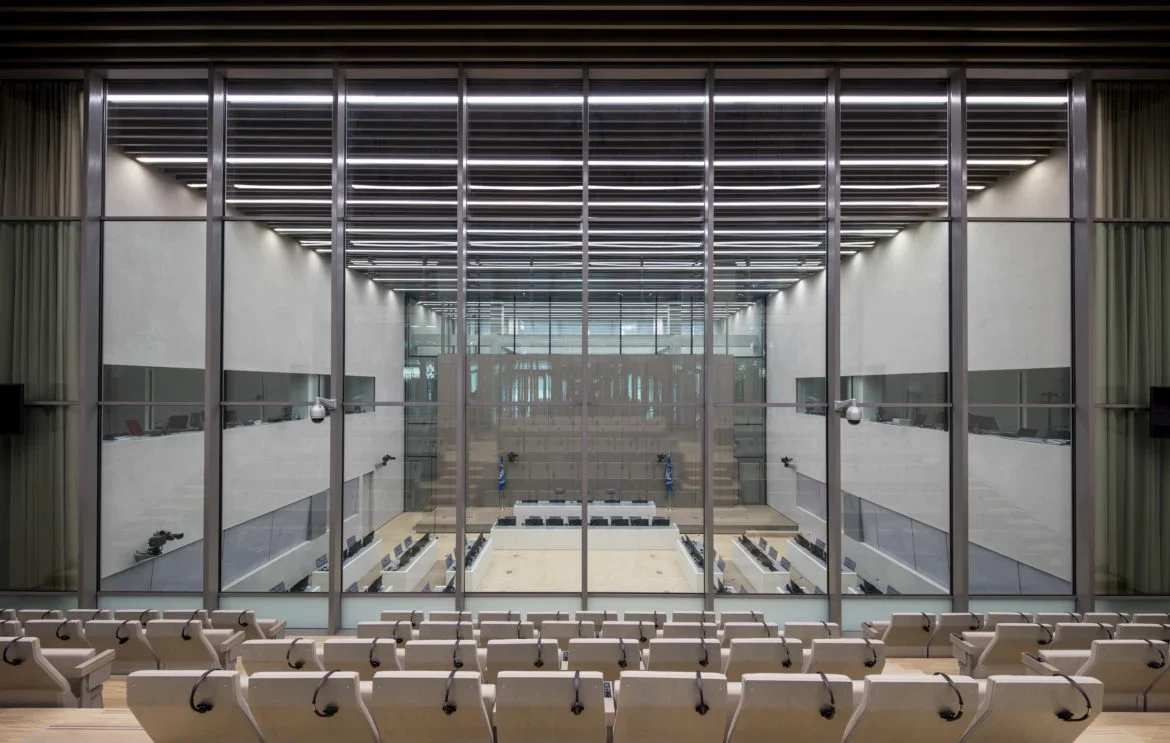
Defending before the International Criminal Court
An Interview with Mylène Dimitri
Edited by Cailan Cumming, Kate Gibson & Paul Williams
A Note on Defending Justice
This blog is part of the Defending Justice series, an initiative of the Public International Law and Policy Group (PILPG) to promote an eclectic array of voices within the field of international criminal law.
As part of our broader efforts to strengthen institutions of justice, this series seeks to create space for dialogue around the varied perspectives and concerns that shape these institutions. With that aim in mind, we interviewed a series of defense practitioners working in international criminal law and distilled their experiences and insights into a series of first-person blogs, preserving the spirit and voice of those interviews.
Editor’s Note
This monograph delves into the inner workings of the International Criminal Court (ICC) through the lens of Mylène Dimitri, who has acted as Lead Counsel for an accused before the ICC. By comparing her experiences as Counsel before the ICC and the International Criminal Tribunal for Rwanda (ICTR), Dimitri highlights the unique challenges the ICC’s legal framework presents for defense counsel and the pursuit of fair trials. She offers insight into her strategies for working with diverse clients, victims, and witnesses while navigating these challenges and upholding her professional ethos as an officer of the court. Drawing on 23 years of defending cases at international tribunals, Dimitri illustrates that being an effective defense lawyer requires resourcefulness, integrity, and a relentless drive to ensure fair trials. Like many defense lawyers, Dimitri believes deeply in the ICC’s mission to help societies move beyond cycles of conflict and prevent future atrocity crimes. To help realize that mission, she provides readers with a strong vision for the future of the ICC, one in which victims are heard and supported and defendants’ rights are upheld.
Introduction
The International Criminal Court, established by the 1998 Rome Statute and seated in The Hague, was founded to prosecute individuals for the most serious crimes: genocide, crimes against humanity, war crimes, and the crime of aggression. As the first permanent international court of its kind, the ICC was envisioned to be a symbol of global accountability and the rule of law. Yet, for those working within its system, and especially defense counsel, the Court presents a unique set of structural and procedural challenges that distinguish it from previous ad hoc tribunals that prosecuted the same international crimes.
I entered the field of international criminal law at a time when the ICTR and International Criminal Tribunal for the former Yugoslavia (ICTY) were still at the center of post-conflict justice efforts. From 2002 to 2006, I moved from intern to full-time legal assistant at a Canadian law firm handling international criminal cases in Arusha, Tanzania, which was the seat of the ICTR. I went on to be Co-Counsel in the first Canadian case tried under the country’s national Genocide Act in 2006. From there, my path took me back to Tanzania, where I worked on another ICTR case until 2015, and then became Co-Counsel for the Special Tribunal for Lebanon, before becoming Lead Counsel before the ICC.
Defending Before the ICC vs. Ad Hoc Tribunals
Legal Framework
The ICTR was established through a United Nations Security Council resolution and its procedural framework leaned more heavily on common law practices. This offered a certain clarity and predictability to the courtroom proceedings and trial procedures followed an ordered process familiar to adversarial systems. By contrast, the ICC was created through a multilateral treaty—the Rome Statute—and incorporates elements from both common law and civil law traditions, resulting in a hybrid legal system that is both ambitious and, at times, unwieldy. While this is intended to serve as a more representative international legal model, it has, in practice, introduced considerable complexity and challenges into legal proceedings.
The mixture of legal traditions at the ICC gives rise to interpretative uncertainty, as judges and counsel must navigate conflicting procedural presumptions—an issue not typically encountered in tribunals grounded in a single legal system. Civil law and common law systems on their own each have consistency and safeguards, but when combined, the logic of the procedure and the procedural safeguards of the system can diminish. For example, drafters from Romano-Germanic legal systems insisted on including a confirmation phase at the ICC, akin to the procedure conducted by an investigating judge in civil law systems. There, the investigating judge plays an active role in collecting all relevant evidence and questioning witnesses before deciding whether a case should proceed to trial. That process is thorough, but also linear and contained.
At the ICC, Article 61 of the Rome Statute introduced a process for confirmation hearings that were intended to serve a similar function of screening cases before trial. However, the ICC’s version lacks the necessary tools and powers that make the civil law procedure effective. For instance, the Pre-Trial Chamber does not call or question witnesses, and the defense is not allowed to cross-examine them at this stage. Instead, the prosecution simply submits written witness statements, and the Chamber bases its decision on these documents alone.
In theory, the confirmation hearing is supposed to allow the defense to challenge the charges. In practice, this is nearly impossible. Without the ability to question witnesses or assess the credibility of the individuals whose testimony underpins the case, the defense is forced to respond to serious allegations based solely on untested paper statements. This strips the confirmation hearing of its intended value and makes it performative rather than substantive.
In civil law systems, once a case is confirmed for trial, the investigating judge continues to play an active role in collecting evidence, gathering documents, and questioning witnesses. In contrast, common law systems rely on adversarial trials where it is crucial to determine which pieces of evidence are admitted during the trial in order for the defense to test the evidence and present their case. At the ICC, however, these two systems are blended in a way that creates procedural confusion. Evidence may be collected and submitted during the trial phase, yet decisions on admissibility are frequently deferred until the judgment stage, leaving the defense uncertain as to which material will ultimately be considered by the judges. In cases arising from conflicts that occurred within the last decade, the magnitude of available evidence—driven by the widespread use of smartphones and social media—is unprecedented. In this context, the submission regime, which permits the large-scale submission of material while postponing admissibility determinations, creates an immense burden on the defense and generates significant uncertainty in the development of defense strategy, particularly with respect to how specific pieces of evidence should be addressed, challenged, or prioritised.
The ability to call witnesses or rely on documents during trial often hinges on whether those materials are formally admitted. At the ICC, the defense may not know what has been admitted until late in the proceedings, hindering trial preparation and strategy. Ultimately, the combination of a civil law–style pre-trial investigation phase led by an investigative judge and a common law–style adversarial courtroom process creates procedural tensions that can be fundamentally incompatible, to the detriment of the suspect or accused.
This tension also becomes visible in the ICC’s treatment of witness statements. In civil law systems, an investigating judge conducts witness interviews and records both the questions and the answers in detail. The defense has access to the full record, which provides essential context and allows the defense to assess credibility and prepare informed questions if the witness is later called to testify at trial. The opportunity to examine the witness on their statement is a key procedural safeguard. At the ICC, however, the defense may receive only a sanitized statement of the witness's statement prepared by the investigator. Without access to the actual questions asked, the ability to effectively cross-examine the witness is significantly diminished, undermining a key procedural safeguard.
The framework of criminal proceedings in the civil law tradition works, as does the framework in the common law tradition. The mixture, however, has created procedural difficulties to the detriment of the judicial certainty for a suspect or an accused. The ICC’s hybrid system, while well-intentioned, often gives rise to significant challenges that strike at the heart of the procedural safeguards designed to protect the rights of the accused.
Length
I participated in a roundtable hosted by the Nuremberg Academy on one of the most pressing issues facing the ICC today: the length of its proceedings. During the discussion, I raised two central factors that, in my view, significantly contribute to these delays—the confirmation of charges process and the redaction regime.
As mentioned, the confirmation of charges hearing relies on the prosecution’s written statements. In reality, the prosecution frequently asks to delay proceedings so that it can continue investigating and strengthen its case. It is easy to see how months, if not years, can pass before a trial even starts. The ICC’s three-stage burden of proof structure compounds this issue. The procedure moves from a warrant of arrest based on “reasonable grounds to believe,” to confirmation of charges based on “substantial grounds to believe,” and finally to trial, where the standard for a factual finding is “beyond reasonable doubt.” This means in practical terms that the same evidence can be assessed at each stage, but is assessed in accordance to the different standard of proof, greatly lengthening the process. Each of these stages introduces a layer of delay, particularly where procedural design choices made at the outset contribute to the overall length and complexity of the proceedings.
Although perhaps less obvious, the second major issue contributing to lengthy trials is redactions. Each ICC Pre-Trial Chamber will adopt a redaction protocol, which governs the parties’ ability to apply redactions to the evidence. However, witness statements often arrive from the prosecution heavily redacted because the prosecution is permitted to apply "standard redactions" to witness statements in order to protect what it defines as innocent third parties, family members, or witness locations. However, in many cases, these redactions hinder the defense's ability to investigate the case. For example, if a witness is alleged to have been a child soldier, redacting the names of family members makes it impossible for the defense to verify his background—such as where he went to school, when he was born, or whether he was indeed associated with an armed group. A witness might claim that their house was burned down and that a neighbor witnessed it, yet the neighbor’s name is redacted and we are left unable to verify even the most basic facts of the case.
These are core components of the allegations against an accused, and where the defense is prevented from conducting meaningful investigations, the right to a fair trial is undermined. The lifting of redactions can require months of iterative correspondence with the prosecution, during which time the defense remains unable to assess or act upon key material. This redaction regime is resource-intensive and time-consuming, generates extensive litigation, and places a significant burden on the defense, thereby contributing to delays, procedural inefficiencies, and inequality of arms.
These concerns have been raised repeatedly before the Chambers, in particular Trial Chambers, which have on numerous occasions recognized the legitimacy of defense requests and granted appropriate relief. Nevertheless, the issue remains recurrent, as the prosecution has not consistently adapted its redaction practices to reflect the applicable jurisprudence and the principles it sets out. As a result, similar disputes continue to arise, leading not only to delays for the defense but also to further postponements of proceedings, including requests by the prosecution for extensions of time or adjournments of confirmation hearings due to the protracted and complex redaction process. In this context, witnesses to crimes who are central to the allegations should not automatically be treated as “innocent third parties.”
The cumulative effect of redactions is staggering. A single witness statement might have dozens of redactions. Multiply that by hundreds of statements, and you have a defense team forced to write constant requests to the prosecution just to access the basic information necessary to perform our duties as defense counsel—information that is not for public access, but for our own use as officers of the court, bound by confidentiality and strict codes of conduct. Each request leads to further delay, more litigation, and a heavier administrative burden on everyone involved.
By contrast, at the ICTR, defense teams were trusted. We received full disclosure with few to no redactions, which allowed us to begin our investigations right away. The ability to act promptly had a direct impact on the overall length of proceedings, as defense teams could prepare for trial as soon as the arrest was made, corroborating or challenging witness accounts without delay. While some ICTR trials were long, particularly in multi-accused cases, the overall structure allowed for a much more efficient judicial process. At the ICC, the path from arrest to final judgment is markedly longer, which again interferes with the rights of the accused to trial without undue delay.
Location and Access
At the ICTR, the Court’s proximity to the field brought it closer to the realities of the conflict—the people, the terrain, the culture, and the challenges of building a defense case. This translated into a hands-on, pragmatic approach by defense counsel that tried to compensate for the very real obstacles to investigating in post-genocide Rwanda. These obstacles ranged from witness’s inability to cross borders from Arusha to Kigali or Goma due to fear of retaliation, or losing access to key witnesses during the rainy season, for example. Importantly, the Tribunal recognized these challenges, and facilitated sauf-conduits for refugee witnesses living in exile and arranged for defense witnesses to travel discreetly through Uganda or Kenya before flying to Arusha, knowing the risks that many witnesses cooperating with the defense could face.
This pragmatism extended to the structure of the Tribunal itself. Sections of the ICTR Registry, such as the External Relations and Cooperation Section, worked directly with defense teams and did not require that all communication be funneled through the defense section, which reduced the lengthy bureaucracy often faced by defense teams at other courts. I was able to send all of my cooperation requests necessary for investigations, whether for immigration records, telecoms data, passports, or border entries, directly to this office. They acted as my voice in communication with foreign authorities, and the process worked efficiently. This enabled more direct communication, faster responses to cooperation requests, immediate visibility into the status of requests, and fewer errors caused by intermediary delays in reaching out to organizations or states.
At the ICC, however, a multilayered and opaque system has restricted this direct access. As defense counsel, I am required to submit cooperation requests to the Counsel Support Section, which then forwards them to the External Relations Section. That office, in turn, transmits the request to the relevant country office. At no stage am I copied on the correspondence or allowed to follow up directly. This lack of trust in defense counsel creates unnecessary layers of bureaucracy and delay, and leads to duplication of effort. The result is a process that wastes valuable ICC resources and slows the defense’s ability to conduct timely investigations. These inefficiencies could be significantly reduced if the defense were trusted with direct access and support, as was the case at the ICTR.
Jurisprudence
When I compare my experience at the ICTR with what I have seen at the ICC, one of the most striking differences lies in the coherence and authority of jurisprudence. At the ICTR, appellate jurisprudence provided a clear legal roadmap. The ICTR Appeals Chamber judges were elected for four-year terms, but many were re-elected and remained for many years. As a result, there was consistency in how they approached the law. You knew where the judges stood on key points of law, on their interpretations, for example, of modes of liability, the chapeau elements of international crimes, defects of an indictment, or evidentiary provisions like hearsay or Rule 92 bis, which allows the admission of certain written testimony. These legal standards were clearly articulated and repeated over several decisions or judgments, and appellate jurisprudence was binding on the Trial Chambers. The principle of stare decisis, or reliance on precedent, was effective and applied, giving defense teams, the prosecution, and the judges a clear framework within which to operate.
This is not the case at the ICC. Trial Chambers are not formally bound by prior decisions of the Appeals Chamber, and the Court’s jurisprudence has developed in a manner that reflects a more case-by-case approach. The composition of Chambers evolves over time, as judges are elected for fixed nine-year terms and bring with them diverse legal backgrounds, professional experiences, and judicial traditions. These factors inevitably influence interpretative approaches and the weight accorded to prior decisions.
As a result, jurisprudence on key legal and procedural issues may vary between cases and across Chambers, even within the same situation. This diversity contributes to trials that can differ significantly in structure and approach, and to legal standards that may evolve differently depending on the composition of the Chamber seized of the matter. For example, I have seen completely different approaches taken to witness preparation, submission of prior recorded testimony under Rule 68(3) of the Rules of Procedure and Evidence, and the submission of evidence. In some cases, the same witness can testify in two different trials of the same situation, but the rulings on how their statements are treated will vary. This kind of inconsistency creates a lack of continuity and coherence in ICC case law and procedure, weakening the clarity of the judgements and rules that come out of the ICC, and undermining the certainty of the law for suspects and accused.
Powers
The ICTR was backed by the authority of the United Nations Security Council and Resolution 955. That gave the Tribunal real enforcement power. The Registry and the Office of the Prosecutor had the capacity to launch large-scale operations to apprehend the accused, and the Trial Chambers could issue binding decisions reminding states of their obligations under international law. That same power extended to the defense. We could request cooperation from states, and if a state failed to comply, the chambers could issue decisions of non-compliance. These mechanisms actually worked.
At the ICC, however, the Court must constantly negotiate with states as the powers of the Office of the Prosecutor and the Registry are significantly weaker. Whether it is the Prosecutor trying to secure the execution of an arrest warrant or the defense trying to obtain critical documents, everything depends on the political will of the state in question. When it is in a state’s political interests to protect a suspect, they often refuse to surrender them, regardless of the outstanding warrants or orders issued by the Court. Conversely, when a state sees an opportunity to dispose of an opponent, they will cooperate. That opens the door for politics to influence the administration of justice, creating the perception that the Court’s rules and decisions are applied inconsistently depending on the individuals involved, which ultimately affects the credibility of the ICC institution as a whole.
We have seen this play out in numerous situations. The Central African Republic, for example, has several outstanding arrest warrants that remain unexecuted, mainly because of political alliances between the accused and the current government. The current situation in Palestine has also laid bare the double standards at play. Many states have publicly stated that they will not arrest certain Israeli officials subject to ICC warrants if they enter their territory, despite having previously taken the opposite position regarding Russian officials under similar ICC warrants. Ultimately, this dynamic has contributed to one of the ICC’s most persistent criticisms—that it has focused only on African suspects.
Beyond earlier examples, divergent state practice has become increasingly visible in the execution, or non-execution, of ICC arrest warrants. Recent developments involving Libya illustrate this inconsistency, with differing responses by States Parties to suspects subject to ICC warrants. Similar tensions have arisen in relation to the arrest warrant issued against the Russian President, notably in the differing approaches taken by States Parties such as Hungary and Mongolia. These developments echo earlier patterns observed in other contexts and have contributed to perceptions of selectivity and double standards in the enforcement of the Court’s decisions.
Such inconsistencies have inevitably affected the public image and perceived authority of the International Criminal Court. This is so despite the fact that those working within the institution are broadly committed to strengthening its legitimacy and effectiveness. Ultimately, however, the Court’s authority depends on state cooperation, and the political realities shaping that cooperation are closely linked to the ICC’s institutional design—particularly when contrasted with the ad hoc tribunals such as the ICTY and ICTR, which operated within a markedly different enforcement and political framework.
Tools
As defense counsel, we often have different tools at our disposal depending on the court in which we practice. At the ICTR almost everything was done on paper. It was slow but straightforward. We were not expected to manage large volumes of electronic data. While some digital tools did exist, like basic research software, they were clunky and often inefficient. For example, it would take a significant amount of time just to find a name within the prosecution’s disclosure documents. There was no easy way to search through material, which made building a case incredibly time-consuming.
The ICC, by contrast, is fully electronic. Everything from filing submissions to reviewing disclosure is done through digital platforms. On one hand, this makes things far more efficient, especially for teams working remotely. On the other, the systems are significantly more complex. There is a steep learning curve when you are new to the Court. But once you have adapted, the tools do help streamline some aspects of the work.
That being said, the real challenge today is not just adapting to new technology—it is the sheer volume of electronic evidence we now face. The volume of electronic evidence collected by the prosecution, or available for the defense to collect, has reached levels never seen before. The situation in the Central African Republic (CAR) serves as a telling example: the prosecution has described it as the largest collection of evidence it has ever handled. Now consider the scale of evidence in contexts such as Palestine-Israel, or Ukraine-Russia. The volume of videos posted online, social media data, and call data records is staggering—almost unimaginable. This explosion of digital evidence demands urgent procedural and technological adaptations by the ICC to ensure fair trial rights and equality of arms.
To maintain fairness, the ICC must swiftly adopt measures similar to those implemented at the ICTR and the Special Tribunal for Lebanon. For example, the Office of the Prosecutor at the ICC has acquired a new e-discovery and data analysis tool capable of managing and analyzing massive volumes of electronic evidence. It allows them to search, filter, and organize vast amounts of digital data before it is even disclosed. It is critical that this tool also be made available to the defense, in line with jurisprudence from both the ICTR and STL, which have both recognized the importance of equal access to technological tools used in the preparation of cases.
The Practice of Defense in International Tribunals
Cultural Considerations in Building a Defense Team
In an international setting the relevant cultural context does not only apply to the location of the tribunal and the state in which the accused is from, but also refers to the culture and backgrounds of Judges, witnesses, prosecutors, and local authorities. Culture shapes how witnesses answer questions, how judges interpret the law, how prosecutors present their cases, and how local authorities respond to defense requests. In order to successfully navigate this cultural context, defense counsel must be extremely adaptable, build a diverse defense team, and work to understand people from a variety of backgrounds. I myself have had to rewire some of the ways in which I was trained. What worked in my own legal culture did not always translate, and I had to be willing to listen and step outside that framework. Often, this meant relying on others and learning from colleagues from the situation country, and passing that knowledge down to others.
A strong defense team must reflect the diversity of the international environment in which we operate. It is not just about legal skill, but also about having a range of perspectives. Defense teams need to include people from different legal traditions, cultural backgrounds, nationalities, and genders. But beyond that, you want people who do not think exactly like you do. You want your biases checked, ideas challenged, and defense strategies tested.
Having someone from the situation country is absolutely essential. They bring contextual knowledge and instinctive understanding that you simply cannot get from books or reports. For example, defense counsel does not approach a witness or navigate a courtroom the same way in different places and team members from the situation country can advise on culturally appropriate conduct, such as what gestures or language are considered respectful, and what should be avoided. Failing to understand local customs can unintentionally offend a witness and risk undermining their willingness to cooperate.
At the ICTR, a Rwandan lawyer always sat beside the senior trial attorney of the prosecution during hearings. They communicated constantly, clarifying terms, explaining references, and helping ensure that testimony was understood in its proper context. On the defense side, having someone assist or check the defense’s interpretation helped to verify facts the witness mentioned in real time: who a public figure was, where a town was located, how many daily prayers occur in a particular region, etc. At the ICC, I have not seen the same kind of support. In cases from the Central African Republic or Democratic Republic of the Congo, there was no equivalent counterpart with deep local knowledge and authority alongside counsel.
Cultural Considerations for Witnesses, Judges, and National Authorities
Before working with a witness, I gather information about their background such as their gender, religion, education level, occupation, literacy, or social position. For example, I may assess whether they are a vulnerable witness or if there are religious sensitivities that should be respected. In cases involving allegations of sexual or gender-based violence, I consider what approach would ensure sensitivity and care. In some contexts, this may mean seeking the husband’s permission to speak with a woman or ensuring that a female team member is present during an interview. I also learn basic words and greetings in the local language which is a simple but meaningful sign of respect that often helps put the witness at ease from the outset.
In some places, witnesses perceive and relate to the world differently, such as in their perceptions of time and distance. A witness might say an event happened "during the rainy season" or refer to a local event, crop, or natural phenomenon to indicate a time period. They might refer to a location that was "a 15-minute walk away" rather than describe that location in terms of meters or kilometers. Importantly, insisting on rigid formats like exact dates or quantified distances might make someone uncomfortable, or even ashamed if they feel they are not answering “correctly,” which is not only unhelpful but can also affect the quality of testimony.
Culture not only influences witnesses, but can extend to judges as well. When preparing a defense strategy, I always research the bench. Where does each judge come from? What legal tradition shapes their thinking? What positions have they taken in the past? Knowing whether a judge comes from a common law or civil law background, and what issues they tend to be firm on, helps determine both legal arguments and courtroom advocacy. When preparing a point of law motion, I often reach out to a Judge from the same home jurisdiction as the presiding judge to ask how that issue is typically treated within their home jurisdiction and how the law might be interpreted.
Dealing with national authorities, in particular, requires patience, perseverance, and a nuanced understanding of local dynamics. When I submit a cooperation request or seek to obtain documents from state authorities, I tailor my approach to what is needed within that local environment. Do I need to make an appointment? Wait in a hallway for hours? Should I express urgency or remain quiet? Each environment demands something different, and being an effective lawyer means knowing how to read those signals and adapt accordingly.
Building Relationships with Clients
Cultural differences also impact the client. Clients are diverse. One day you may represent someone who grew up in a rural village with little formal education, and the next, someone highly educated and part of their country’s elite. No two clients are alike. I adapt my communication style to their level of knowledge, their background, their personality, and their behavior. In some cases, that may also mean adjusting how I communicate with the client’s family.
My job is not just to defend, but to inform. A client must be empowered to make decisions based on an informed understanding of the law, the strategy, and the risks as you are ultimately working under their instruction. Sometimes a client understands everything quickly. Other times, it takes hours of conversation, explaining the law in simpler or more familiar terms, or debriefing them extensively after a decision. There is also a psychological dimension to this work and engaging with the client. These are individuals under an immense amount of stress. Even when I know a particular decision or negotiation is in their best interest, I have to choose the right moment to bring it to them. You have to know when they are ready to engage in that conversation.
Some of our clients come from civil law systems where cross-examination does not exist. When they enter the courtroom, they are confronted with an adversarial model they have never seen before. The disorientation they feel can affect how they testify, how they engage with the court, and how they understand the process. At the beginning, defense counsel does not automatically have the client’s trust. In fact, we expect the opposite. Most clients come into this process with deep suspicion. They have been arrested in their home country, flown to Europe, imprisoned, and brought into a courtroom full of foreigners. From their perspective, we are all part of the same institution that is trying to convict them, including the defense team. That perception does not go away just because I tell them I am acting in their interests. Trust is built slowly and through action. When a client sees me stand up in court and argue forcefully on their behalf—arguing with the Judge, arguing with the Prosecution, and taking every opportunity to object—that is when they begin to believe that you are truly working for them.
I have seen how hard it can be to overcome these suspicions. At the Special Tribunal for Lebanon, for instance, Hezbollah told its members and supporters not to cooperate with the defense teams because we were seen as part of the court established to convict them. Even though we fought hard against this and even secured an acquittal the first time around, conducting investigations in Lebanon under those conditions was practically impossible.
As the relationship with the client builds, I listen carefully to assess whether trust is growing. I never hide anything from my client. As defense counsel you must be transparent. You tell him why you are negotiating something, and every time you are filing something. Then the client will understand why you are doing the things that you are doing and why it is in the client’s best interest. That is how you gain the client’s trust. Honesty, transparency, and patience are the three words I would use for building this relationship.
Victim Participation at the ICC
One of the most distinctive aspects of practicing before the ICC is navigating the framework for victim participation. Unlike traditional adversarial systems, where only the prosecution and defense have roles in trial, the Rome Statute allows for victims, through their legal representatives, to present their views and concerns. Victims are not abstract characters, but are individuals who have suffered, and their experiences deserve to be acknowledged and interests represented. However, the extent to which victim participation serves its intended purpose depends on how the legal representative understands and approaches their role.
Under the Rome Statute, the role of victims’ counsel is to assist their clients in expressing how they have suffered and to communicate their concerns to the Court. Many victims’ representatives respect these boundaries and do not place their clients on the stand as factual witnesses, instructing them to refrain from commenting on the accused. Their statements focus on the impact of the crimes on their own lives, not on the guilt or innocence of the accused. In such cases, victim participation can contribute meaningfully to the accountability process without compromising its integrity. But in some other cases, victims’ representatives see themselves as a second prosecutor, actively seeking a conviction and demanding one. They encourage their clients to testify against the accused and pursue lines of questioning related to the charges, rather than limiting their role to presenting views and concerns.
The defense is already entering cases years after the prosecution has begun its investigations. Our resources and time are limited. We plan our trial strategy based on the prosecution’s case and the evidence it presents. But when a victims’ legal representative decides to call their client as a factual witness, we are notified very late in the proceedings—after we have already done our fieldwork, made strategic choices, and submitted evidence. Suddenly you can have new witnesses, new allegations, new evidence, and new crime scenes that are introduced after the prosecution closes. In an adversarial system, there is no safeguard for this because in common law we do not have ‘two prosecutors’.
No one denies that victims have suffered—many defense lawyers, myself included, believe deeply in the work of the ICC and other international tribunals in breaking cycles of conflict and ensuring that atrocity crimes are never repeated. Recognizing the victim’s voice helps to achieve this by restoring a sense of humanity to the accountability process. But accountability must be achieved through a fair process, and not at the expense of the rights of the accused. Victims’ voices should be heard, but always within the clearly defined limits of the Rome Statute.
The appropriate venue for compensation for victims is at the reparations phase, supported by mechanisms like the Trust Fund for Victims. That is where recognition and redress can be meaningfully provided by a proper and fair reparation system. This is a critical stage, and I have seen firsthand what happens when there is no proper follow-through on reparations. At the Special Tribunal for Lebanon, even after a conviction, victims felt little closure. There was no compensation, no support, no material acknowledgment of their suffering. The trial may have ended, but nothing was repaired.
The current system for reparations at the ICC faces significant challenges in assessing and qualifying victim participation, particularly in complex, conflict-affected contexts. The ICC, NGOs, and UN programs offer benefits to those who qualify as a victim and some people apply because they are desperate—because their families are hungry, their homes are gone, and their livelihoods destroyed. In many situations, victims have suffered profoundly, because of the conflict itself and, in some cases, as a result of the acts of alleged perpetrators. However, while the harm experienced is real and often acute, the causal link to a specific suspect or accused is not always straightforward. Their suffering and need for financial support is real, even though their qualification as a victim in a particular case may not be.
At the same time, the ICC has become a focal point of hope for many affected communities. Expectations have been created, sometimes understandably so, that recognition as a victim before the Court will translate into tangible assistance or financial support. These expectations have contributed to reparations proceedings involving extremely large numbers of victims. In the case against Thomas Lubanga Dyilo, for example, the number of former child soldiers assessed in the reparations phase reached into the hundreds of thousands. This situation is completely unmanageable and unrealistic.
Similar dynamics can be observed in other cases. Despite the very substantial reparations awards ordered in the cases of Bosco Ntaganda and Dominic Ongwen, it is my understanding that, to date, no reparations have yet been effectively distributed to victims. The process appears highly complex and lengthy, and the gap between judicial decisions and their concrete implementation risks deepening frustration among victims whose hopes and expectations remain unmet.
This situation suggests that reparations mechanisms may benefit from a more focused approach, one that prioritises direct victims with a clearer nexus to the crimes for which an accused has been convicted, while still recognizing the broader suffering caused by conflict. There must be a way to reconcile legal precision with the humanitarian realities faced by affected populations. The challenges are compounded by the limited resources available to the external teams of legal representatives of victims during the reparations phase, which often restricts their ability to conduct field missions, consult meaningfully with clients, and follow up on implementation. This, in turn, affects both the expeditiousness of proceedings and the depth and quality of the reparations debate.
The problem is compounded by the limited transparency afforded to the defense. Unless a participating victim also appears as a witness, the defense has no access to the victim’s identity and little to no information regarding who is participating in the proceedings. In the absence of identities or basic factual information, the defense is unable to verify whether the legal criteria for victim participation are met. This lack of disclosure affects not only the fairness of the proceedings but also the integrity of the reparations process as a whole. Defense counsel are officers of the Court, bound by strict confidentiality obligations and professional codes of conduct. Disclosure of victim identities to the defense, subject to appropriate protective measures, would not place victims at risk but would instead enable meaningful verification and contribute to a more balanced process.
Importantly, these limitations also have consequences for genuine victims, including indirect victims. Experience has shown that instances of fraudulent participation have come to light only where victims also held witness status or otherwise had a dual role in the proceedings. In other cases, where the defense does not receive the victim application forms or sufficient underlying information, it is simply not in a position to carry out comparable verification. The presence of fraudulent or ineligible participants inevitably affects the allocation of limited reparations and risks diluting the relief available to those victims who are directly and legitimately entitled to it.
We do not distribute or disclose the identities of prosecution witnesses, who benefit from protective measures, and in the same way will never disclose the identities of victims. But when someone is described as a child soldier and later turns out to have been 20 years old at the time of recruitment, or when a person claims to be displaced but has in fact always lived in the same home, it reveals a serious gap in the verification process. Such errors damage the credibility of the Court and dilute the meaning of victim participation. If a conviction occurs, the reparations should be directed to genuine victims, not to individuals who do not meet the criteria of the process.
The current approach also delays justice for genuine victims. Because the bar for inclusion is so low, many applications are not properly checked at the outset and many non-qualifying victims participate. Only during the reparations phase does the Registry filter the list of victims based on the criteria to determine who should receive the benefits. This wastes time, doubles the workload, and drains resources that could be better used to support actual victims. Eligibility should be properly assessed at the start, not the end. In addition, I believe that reparations should not be tied exclusively to convictions. Conflict always produces victims, regardless of who is eventually found guilty. There must be a way to acknowledge and support those individuals without victims having to rely solely on convictions.
Future of the ICC
If the ICC’s mission is to fight impunity, it must remain above political pressure. Yet recent developments have raised serious concerns about the Court’s independence. In the Palestine situation, the ICC Prosecutor announced his application for arrest warrants publicly—before the warrants had been granted, confirmed, or published by the Court. This was a clear departure from the approach taken in the Ukraine situation, where the names of high-ranking officials subject to warrants were only disclosed after the Pre-Trial Chamber had issued the warrants under seal.
The public announcement in the Palestine situation sparked a wave of external pressure, including from non-State Parties and some State Parties. The situation escalated to the point where the United States sanctioned four ICC judges, undermining the Court’s perceived independence and eroding the Court’s institutional resilience. Normally, applications for arrest warrants are filed under seal to preserve the integrity of the judicial process. This allows judges in the Pre-Trial Chamber to assess the evidence and deliberate independently on whether to confirm the arrest warrant, free from outside influence or pressure. While there may be exceptional circumstances where public disclosure of an application is justified—for example, to facilitate cooperation or enhance the collection of evidence—this must remain the exception, not the rule.
The turmoil generated by the premature publicity surrounding certain arrest warrant applications demonstrated the very real risks associated with departing from this approach. In response, ICC judges themselves acknowledged these concerns and subsequently amended the applicable framework governing the publicity of arrest warrants, reaffirming that confidentiality is the default and that publicity must be carefully circumscribed. This evolution underscores the recognition that undue disclosure opens the door to political interference. When external actors are drawn into the process before an application is properly assessed, or when amicus curiae submissions are entertained without access to the underlying evidentiary materials, the proceedings risk becoming politicized. Such developments threaten to undermine the Court’s independence and, ultimately, its legitimacy.
Conclusion
Defending before the ICC requires navigating a complex and evolving legal terrain. The Court’s hybrid procedural framework, drawing from both civil and common law traditions, was conceived as an inclusive model, yet in practice it has generated significant operational challenges. These include lengthy proceedings, procedural fragmentation, and heavy administrative demands, all of which affect the pace and efficiency of trials. Beyond these structural features, a persistent lack of institutional trust in the defense has contributed to layers of bureaucracy and resource-intensive processes that could, with greater confidence in defense teams as officers of the Court, be substantially streamlined. Reducing the number of formal communication channels through which defense counsel must operate would alone alleviate unnecessary delays and administrative burdens, without compromising fairness or transparency.
Importantly, the way defense counsel operate at the ICC extends well beyond legal strategy. Defense teams engage daily with profoundly human realities: clients facing life-altering charges, witnesses and victims shaped by conflict, and field investigations conducted under difficult and often dangerous conditions. Professionalism, adaptability, and ethical responsibility remain central to this work, particularly in politically sensitive and high-profile cases.
One structural issue nevertheless warrants reflection: the enduring mistrust of the defense, which continues to shape institutional practices and perceptions. This mistrust has tangible consequences. In some instances, it has resulted in extensive redactions, restricted access to materials, and heightened scrutiny of defense activities, sometimes linked to Article 70 proceedings against defense team members—such as in the Bemba et al. case, or investigations touching defense teams or accused in Ngaïssona and Ntaganda. While accountability mechanisms are essential, their selective visibility risks distorting the institutional narrative surrounding defense conduct.
This imbalance becomes more apparent when contrasted with the treatment of other actors. In Lubanga, despite judicial findings that intermediaries had participated in the fabrication of evidence, no Article 70 proceedings were initiated against them. Similarly, in the Yekatom case, the defense raised and substantiated allegations of evidence fabrication involving intermediaries and alleged child soldier witnesses and participating victims. These arguments led the Prosecution to withdraw reliance on certain witnesses and ultimately contributed to the acquittal of Mr. Yekatom on all charges related to child soldiering. Yet, to date, no known proceedings were initiated against those who allegedly falsified age or group affiliation. The absence of equivalent scrutiny across actors inevitably shapes perceptions of fairness and fuels the very mistrust that the system seeks to prevent.
Had the ICC adopted an institutional model providing for an independent prosecutorial mechanism for Article 70 investigations, similar to those employed at the ICTR or the Special Tribunal for Lebanon, the focus of such proceedings might have been more evenly distributed. Instead, the recurrent association of Article 70 investigations with defense teams risks reinforcing a narrative that undermines confidence in the defense as a pillar of the justice process.
Looking ahead, meaningful progress will depend not on diminishing the role of victims or their representatives, but on recalibrating institutional trust. Greater confidence in defense counsel, more proportionate administrative controls, improved disclosure practices, and streamlined procedural pathways would enhance both efficiency and fairness. Ensuring that all actors—prosecution, defense, intermediaries, and witnesses—are equally accountable for interference with the administration of justice is equally essential. In doing so, the Court would strengthen its legitimacy and better align its practices with the principles that underpinned its creation. Defense counsel will continue to safeguard due process and fair trial rights, ensuring that the promise of international justice is fulfilled not only in outcomes, but in the integrity of the procedures themselves.