
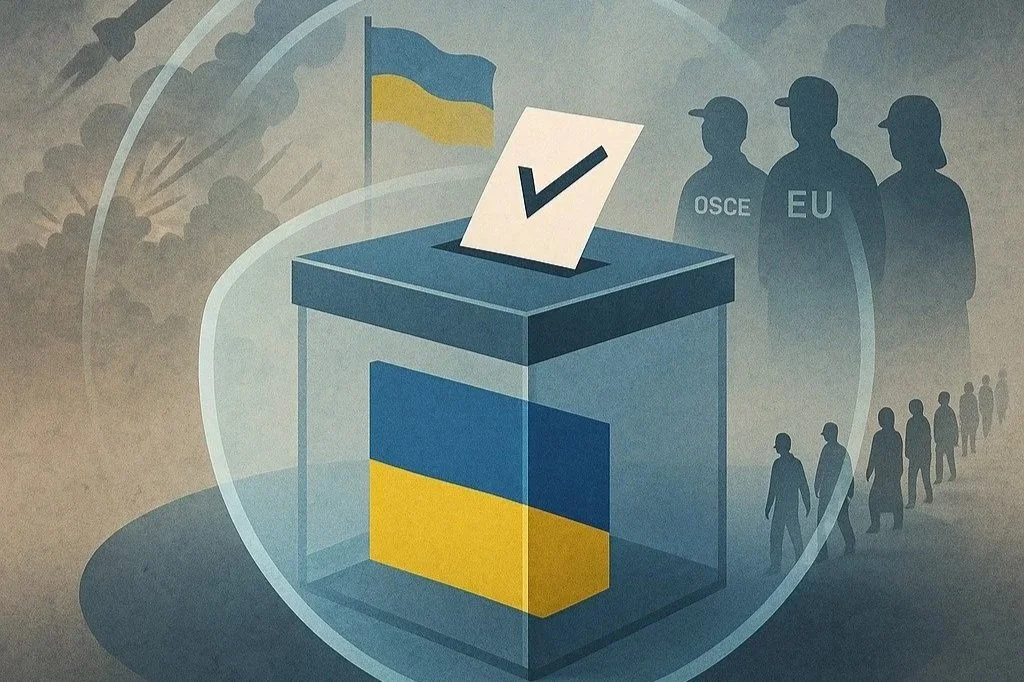
Elections in Ukraine: Between Peace Demands and Democratic Integrity
By: Dr. Paul R. Williams* and Sindija Beta**
As Ukraine navigates the most consequential peace negotiations in its modern history, the question of elections has again resurfaced during the most recent peace agreement drafts. The recently publicized 28-point plan, allegedly drafted by US and Russian officials, places elections soon after the cessation of hostilities as a requirement of any settlement. More recently, US President Trump accused Zelenskyy of prolonging the war to avoid holding elections, in response to which President Zelenskyy announced his readiness to hold elections even during martial law should security be ensured.
Nonetheless, the unavoidable questions and issues that arise when elections in Ukraine are discussed are numerous. Martial law remains in place, during which elections are prohibited, millions of citizens are displaced internally or abroad, and large parts of the country remain under occupation. In this context, elections require more thinking than an arbitrary timeline in a poorly thought-through plan or baseless accusations of President Zelenskyy clinging to power. The challenge is to design an electoral process that is credible, inclusive, and secure, while resisting external pressure to rush toward a vote that could fracture Ukraine's hard-fought legitimacy.
Public debate reflects this tension. Civil society organizations such as Opora have outlined detailed roadmaps for postwar elections, emphasizing legal reform, diaspora inclusion, and international monitoring. Other institutions have likewise highlighted the risks of conducting elections during active armed conflict, noting that fairness and legitimacy are often compromised when security and freedoms are restricted.
Challenges Facing Postwar Elections
There are a number of challenges that hinder Ukraine’s ability to hold elections. Beyond the initial hurdle of finding a legal solution to the prohibition on holding elections under martial law, which is currently in force but could arguably be lifted should a peace agreement be signed, there are other practical challenges to holding free and fair elections in Ukraine. This regards (1) the high numbers of displaced people in Ukraine and abroad, which makes registering voters difficult; and (2) meaningful political participation is restricted to those portions of the population that live under occupation and near the frontlines, as well as for those who have been conscripted to the military. The inability of active-duty soldiers to participate in elections raises serious questions about representation, particularly given the scale of mobilization during the war.
More than six million Ukrainians remain abroad, with millions more internally displaced. Their participation is essential for legitimacy, but the legal framework and infrastructure in place would create significant obstacles for large portions of displaced people to participate in elections. Without secure absentee and diaspora voting, elections risk excluding vast segments of the electorate, creating a democracy that speaks only for those who remained.
Occupied territories present another obstacle. Conducting elections in regions under Russian control would risk legitimizing occupation. Comparative practice from places, such as Afghanistan or Iraq, shows that elections held under coercion or foreign control rarely produce durable legitimacy or peace.
Security of polling stations is another critical concern. In areas close to the frontlines or even in Kyiv, polling places could become targets for Russian intimidation, sabotage, or direct attacks. Protecting voters and election workers will require professional civilian policing, security, international monitoring, and clear protocols to prevent interference by Russia.
This is especially pertinent given Russia’s decades-long practice of interference in elections in other states. Such actions have ranged from disinformation campaigns to direct support for proxy actors, consistently undermining democratic processes.
Indeed, elections held shortly after a ceasefire, let alone during active armed conflict, can be vulnerable to manipulation if the conditions for sovereignty and security are not firmly established. If elections are rushed before Ukraine has secured its institutions and electoral infrastructure, they could become another arena for Russian influence rather than a milestone of democratic renewal.
El Salvador’s Chapultepec Accords illustrate how sequencing matters. Electoral reform was treated as the foundation of peace, with institutional reform and international monitoring as the cornerstone of election preparation. Ukraine faces similar imperatives. Without safeguards and comprehensive security measures in place, which would include support from Ukraine’s allies, elections could legitimize Russian occupation and allow it to further manipulate and interfere with Ukraine’s internal matters or exclude displaced populations, undermining Ukraine’s democracy.
Opora’s roadmap for postwar elections outlines practical steps for holding free and fair elections in Ukraine. These steps include legal and electoral reform for ensuring that all of the population, including displaced persons and those on military duty, can vote, conducting comprehensive security assessments, strengthening the information space to minimize Russian interference, and increasing campaigning transparency, among others. These are not steps that can or should be rushed.
Moreover, narrative control will be central. Russia frames elections as proof of normalization, but Ukraine must counter by insisting on sovereignty-first sequencing. If elections are portrayed as concessions, they risk undermining Ukraine’s democratic identity. If they are framed as sovereign acts of resilience, they can become a powerful symbol of renewal.
Conclusion
Elections in Ukraine will inevitably be a defining feature of the country’s postwar settlement, but they cannot be reduced to a checkbox in a peace plan. Holding elections immediately after a ceasefire, without adequate preparation, risks exposing the process to Russian interference through disinformation campaigns, cyberattacks, and manipulation of voter registries. It also risks disenfranchising millions of displaced Ukrainians who cannot easily access polling stations or register under the current frameworks.
A credible process depends on concrete steps: lifting martial law only once legal safeguards are in place, rebuilding voter registries to include displaced and diaspora populations, and creating security protocols for ensuring the security and integrity of polling stations. When it comes to occupied territories, the situation is even more difficult because voters in these areas, including Crimea and Donbas, should be able to participate in voting, but safeguards are required to ensure they are able to vote freely and that the election does not entrench an illegal occupation.
These are issues that do not currently have solutions, and it would be irresponsible to overlook them due to external pressures.
* Dr. Paul R. Williams is the Co-Founder and Director of the Public International Law & Policy Group and Rebecca Grazier Professor of Law and International Relations at American University
** Sindija Beta is the Legal Officer and Program Manager at the Public International Law & Policy Group